Open source in 2026 is under a new structural pressure that nothing in its history prepared it for: the volume of code, projects, and issues is rising while the number of maintainers, reviewers, and actual users stays the same. AI tools have made the marginal cost of producing a project, an issue, or a pull request close to zero. The cost of evaluating one has not budged.
This page synthesises the three vectors by which that pressure shows up in a real tracker, drawn from Armin Ronacher’s reflection on running the Pi project at Earendil in Building Pi With Pi (2026-05-24).
The Three Vectors
1. Slop Issues Are Worse Than No Issues
In a world where the maintainer’s own agent reads the issue body as part of its prompt, issue quality matters in a new way. A vague issue used to be merely annoying. A confidently-wrong AI-laundered issue is actively harmful: the agent treats the wrong diagnosis as evidence rather than rumour, and follows it down the dead end the reporter’s clanker prepared.
The structural problem: when humans throw a narrow factual observation through an LLM, the LLM expands scope. A single stack trace becomes a wall of plausible-but-wrong hypotheses, fake-minimal repros, “suggested implementation strategies,” and analogies to adjacent but wrong code. Everything reads confident. None of it is verified.
“A bad issue that contains a plausible but wrong diagnosis creates extra work.” — Armin Ronacher
The maintainer-agent response: a slash command (Pi’s /is) with an explicit instruction not to trust the issue body and to derive its own diagnosis from the code. Per Armin, that instruction only partially works, because the upstream prose is already confident.
The reporter-side prescription is unfashionable but correct: report observed facts in your own voice.
- I ran this command.
- I expected this to happen.
- This happened instead.
- Here is the exact error or log.
If you used an LLM to understand the problem, leave that as a follow-up comment, not the issue body. The hard fact is one stack trace; give the stack trace and stop there.
2. Slop Begets Slop: Make Bad State Impossible
The same failure mode shows up in the code AI agents write to fix issues. Told that “this malformed session log crashes the reader,” the present-day clanker will reach for a tolerant reader, then a fallback, then a migration, then more debug output, then a test for all of this. None of these are wrong in isolation. They are the wrong move for the system, because they paper over an invariant that should never have been broken on the write side.
The principle the maintainer keeps having to enforce:
“Almost always, the correct fix is not to handle the bad state, but to make the bad state impossible.” — Armin Ronacher
This is especially load-bearing for persisted data. Pi session logs are opened, branched, compacted, exported, shared, and analysed; a permissive reader hides the defect at every later step. The agent sees a local failure and locally defends against it. The maintainer pulls the conversation back to the global invariant. It is laborious.
This is the same root cause Lalit Maganti names in AI Coding Relativity - Local vs Global: AI is excellent in the local frame and increasingly unreliable in the global one. Architecture is what happens when locally-correct components interact, and you cannot recover it by stitching local correctness together.
The maintainer's mantra
When an agent proposes handling a bad state, ask: can this state simply not exist? Push the constraint into the type, the schema, the write path. Reject the tolerant reader.
3. Volume Is The Problem
Pi’s tracker auto-closes issues and PRs from non-approved contributors (with a manual reopen process). Ninety days of public-tracker data, excluding Earendil members:
| Metric | Number |
|---|---|
| External issues + PRs | 3,145 |
| Auto-closed | 2,504 |
| Issues re-opened | 17% |
| Issues that influenced the codebase (referenced by main-branch commits or merged PRs) | ~26% |
| Pull requests ultimately merged | 8% (60 of 714) |
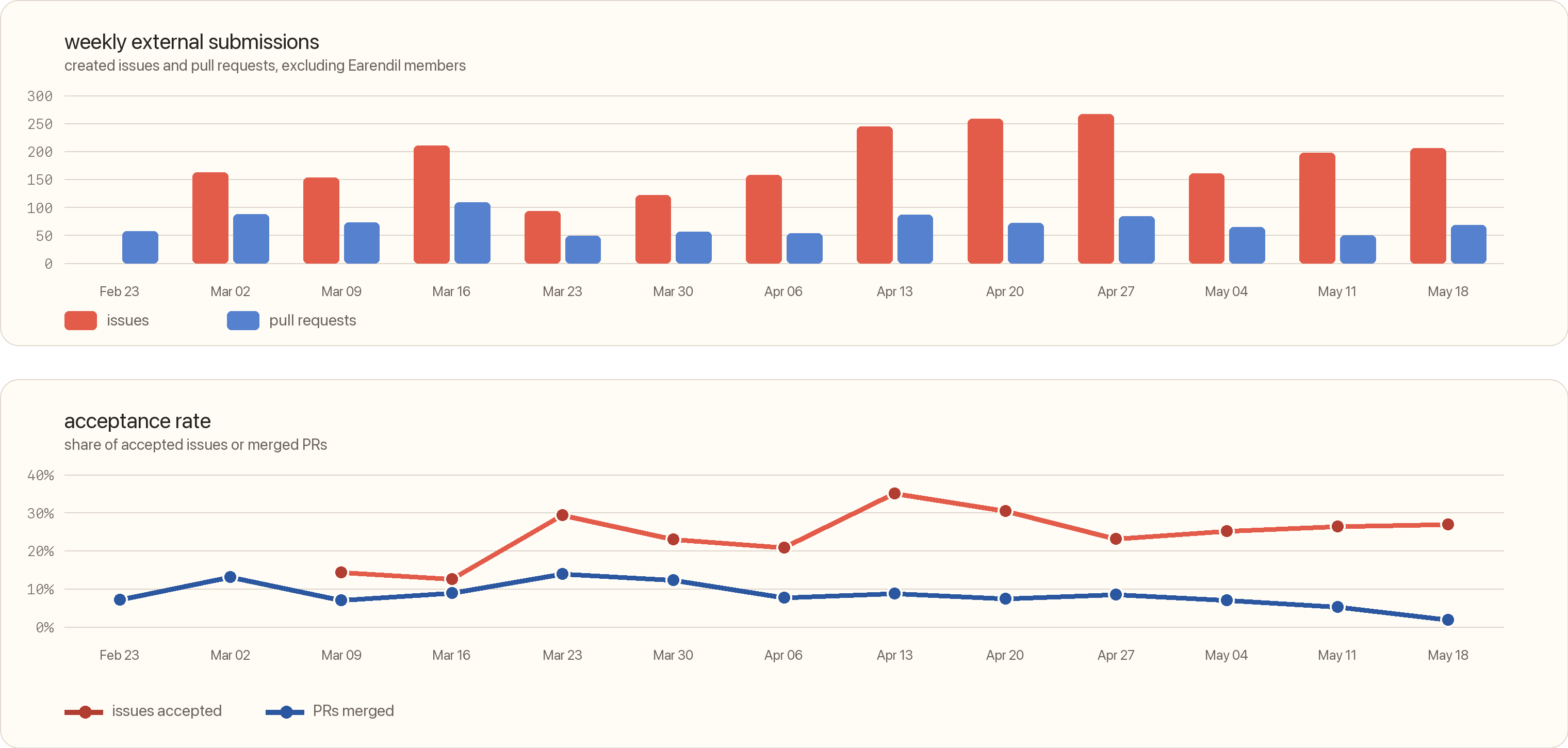
The signal is not just that volume is high — it’s that a vanishing fraction of submissions actually improve the project. Sources of low-quality spam include OpenClaw instances and skills people add to their context that seemingly encourage issue creation. Many reporters didn’t even realise their clanker submitted the issue on their behalf.
Armin’s read: GitHub is not architected for this regime, but the blame belongs less to GitHub than to the people whose tooling makes the experience painful. If your clanker shits on someone else’s issue tracker then it’s not the fault of GitHub, it’s yours alone.
The Collaboration Argument
The first three vectors are tactical. The fourth observation is the load-bearing one.
AI does not increase the number of users who need software, or the number of maintainers who can review it. It mostly increases the amount of code and the number of projects competing for attention. Projects appear with no real users or a temporary audience of one. Stars accumulate; shelf-lives shrink to weeks.
Inside this regime, clankers make local workarounds cheap. The path of least resistance is for one human and one machine to work around a misbehaving dependency in isolation, instead of two humans talking to each other about where the fix belongs. Pi’s discipline (which Armin credits to Mario Zechner) is to refuse to paper over misconfigured upstream gateways and instead push for the upstream fix. “When a gateway behaves correctly, everybody benefits.”
“Open Source needs more collaboration, not more isolated work with a machine. Human communication is hard, and it is tempting to avoid it when you can sit alone with your clanker. But isolation is not where Open Source derives its value.” — Armin Ronacher
The fragmentation is the cost. Effort that should have been shared between two humans instead splits into two isolated human-machine pairs solving the same problem differently. Both projects accumulate local defences against the same upstream defect. Neither maintainer ever talked to the other.
Concrete Workflow: The .pi Folder
A working set of tooling for AI-age maintainership, per Pi’s committed .pi folder:
/is(analyze issue) — labels and assigns the issue, reads the full thread and links, instructs the agent to derive its own diagnosis from code rather than trust the issue body.prompt-url-widget— watches the prompt before the agent starts, recognises a GitHub URL, fetches title+author viagh, renders a small UI widget, and renames the session. Rebuilds state on session start/switch so reopened investigations stay visually distinct./wr(wrap it up) — infers GitHub context from the session, updates the changelog, drafts or posts the final issue comment with an AI-disclaimer, commits only the files changed in that session, addscloses #...when there’s exactly one issue, pushes frommain.
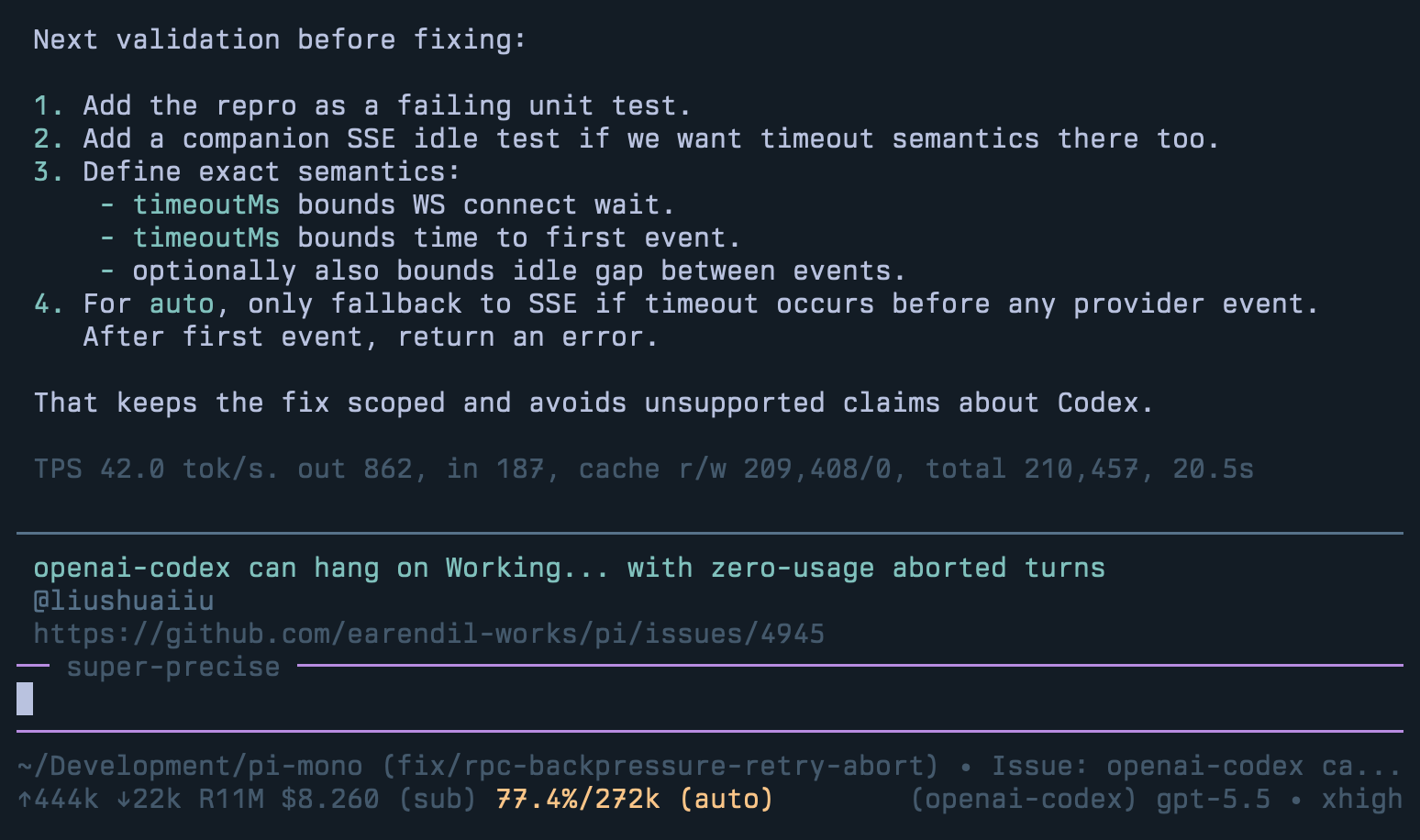
The parallelism this enables is for reproduction, not unattended fixing — several windows running /is against different issues, each visually labelled, then a sequential walk through the investigations once the agents have done their independent reads. Today is a long way from dark-factory automation.
Connections
- Content for Content’s Sake — Ronacher’s prior post diagnosing slop at the language/trust layer; this page is the open-source-tracker layer of the same dynamic
- Agentic Coding - Risks and Discipline — the booboo-compounding pattern, with the make-bad-state-impossible principle as a sharpened tactical addition
- AI Coding Relativity - Local vs Global — the structural reason the agent defaults to local workarounds; the architectural fix lives in the global frame
- Pi (Coding Agent) — the project whose tracker generated the numbers; the
.pifolder lives here - OpenClaw — named as a source of issue-tracker spam (the same minimalism that makes it powerful makes it easy to point at trackers)
- Self-Extending Agents — the maintainer’s job is keeping the invariant; the extension system is where the invariant gets expressed in code
- Earendil — the company stewarding the discipline
- Mario Zechner — Pi’s technical lead, named as the discipline-keeper on refusing local-only workarounds
- Armin Ronacher — author
Sources
- Building Pi With Pi — “Building Pi With Pi” (Armin Ronacher, lucumr.pocoo.org, 2026-05-24)