Comprehension debt is the growing gap between how much code exists in your system and how much of it any human genuinely understands. Addy Osmani’s framing of the AI-coding version of Cognitive Debt: same underlying phenomenon as Margaret-Anne Storey’s concept and MIT’s Your Brain on ChatGPT, told from the angle of the code-understanding gap rather than the team’s shared theory.
The distinguishing property: unlike technical debt, comprehension debt breeds false confidence. Technical debt announces itself through friction (slow builds, the dread of touching one module). Comprehension debt looks clean — green tests, tidy code — and the reckoning arrives quietly, usually at the worst moment.
Source
Comprehension Debt — Addy Osmani, Comprehension Debt (2026). Anchors on Storey’s student-team anecdote and the Anthropic skill-formation RCT.
The one-line version
Making code cheap to generate doesn’t make understanding cheap to skip. The comprehension work is the job.
The speed asymmetry that creates it
AI generates code far faster than humans can evaluate it. The implication is bigger than it sounds, because human review was never just a gate:
- When a teammate writes code, reading their PR forces comprehension — it surfaces hidden assumptions, catches conflicts with how the system was architected months ago, and distributes knowledge across the people maintaining it.
- AI-generated code breaks that loop. The volume is too high, and the output is syntactically clean and superficially correct — precisely the signals that historically triggered merge confidence. Surface correctness is not systemic correctness.
The inversion that breaks review
When code was expensive to produce, senior engineers could review faster than junior engineers could write. AI flips this: a junior engineer can now generate code faster than a senior engineer can critically audit it.
The rate-limiting factor that kept review meaningful has been removed. What used to be a quality gate is now a throughput problem. This is the same constraint Orchestration Tax frames as the GIL/Amdahl bottleneck — comprehension debt is what accrues when production outruns that single serial reviewer.
The skill-formation evidence
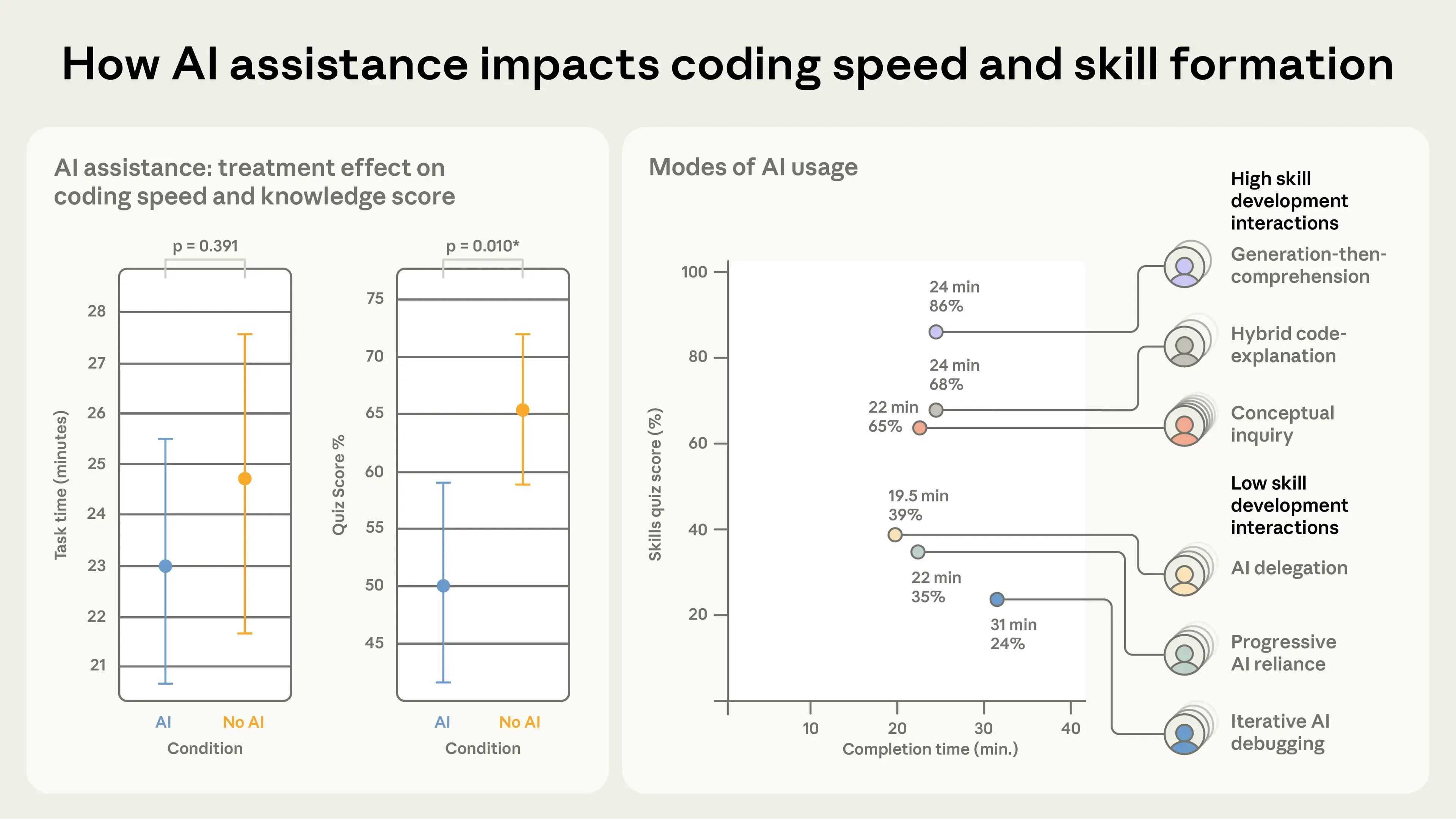
The Anthropic RCT (52 engineers learning a new library) is the empirical anchor: AI-assisted participants finished in roughly the same time but scored 17pp lower on a comprehension quiz (50% vs 67%), with the largest decline in debugging. Osmani’s restatement of the load-bearing finding:
Passive delegation (“just make it work”) impairs skill development far more than active, question-driven use of AI.
Wider data he cites: delegation-style use scores below 40% on comprehension tests; conceptual-inquiry use scores above 65%. The tool doesn’t destroy understanding. How you use it does. (This is the same generate-vs-inquire posture that separates offloading from surrender.)
Why the obvious fixes aren’t sufficient
Osmani works through the two standard escape hatches and shows each has a hard ceiling.
Tests are necessary, not sufficient
- A test suite covering all observable behavior would often be more complex than the code it validates — and complexity you can’t reason about isn’t safety.
- You can’t write a test for behavior you haven’t thought to specify. (“Nobody writes a test asserting dragged items shouldn’t turn transparent” — the failure slips through because no one thought to look there.)
- The sharp failure mode: when AI changes behavior and rewrites hundreds of tests to match, the question shifts from “is this correct?” to “were those changes necessary, and do I have coverage for what I’m not thinking about?” Tests can’t answer that. Only comprehension can.
Specs are appealing, not complete
- Spec-first review (“review the spec, not the code”) is appealing the way Waterfall was. But translating a spec to code involves enormous implicit decisions (edge cases, data structures, error handling, perf tradeoffs) that no spec captures — two engineers implementing one spec produce behaviorally different systems, neither wrong.
- A spec detailed enough to fully describe a program is the program, in a non-executable language — and you still haven’t reviewed what was produced.
- Deeper: there’s often no correct spec. Requirements emerge through building. AI just adds a layer of implicit decisions made without human deliberation. (Tension worth noting against Spec-Driven Development and Writing Specs for AI Coding Agents — Osmani himself wrote the spec framework; here he’s marking its ceiling, not rejecting it.)
The measurement gap (why it’s more insidious than technical debt)
Nothing in your current measurement system captures it.
Velocity, DORA metrics, PR counts, coverage — all look immaculate while comprehension hollows out. Calibration committees see velocity gains; they cannot see comprehension deficits because no measured artifact captures that dimension. The incentive structure optimizes correctly for what it measures; what it measures no longer captures what matters. (Same blind spot as busy vs productive.)
Contrast with technical debt:
| Technical debt | Comprehension debt | |
|---|---|---|
| How it accrues | Conscious tradeoff — you chose the shortcut | Invisibly — aggregate of reviews where code “looked fine” |
| Locatability | You know roughly where it lives | Distributed, unpointable |
| Signal | Mounting friction | False confidence |
| Paydown | Schedulable | Surfaces at the worst moment |
The organizational assumption that reviewed code is understood code no longer holds. Approval now carries implicit endorsement of code nobody fully understood — liability distributed without anyone noticing.
The redistribution: who becomes scarce
What AI changes: cost (dramatically lower), speed (dramatically higher), interpersonal management overhead (≈ zero). What it doesn’t change: the need for someone with deep system context to keep a coherent model of what the codebase does and why.
As AI volume rises, the engineer who genuinely understands the system becomes more valuable, not less — able to look at a diff and know which behaviors are load-bearing, recall why an architectural call was made under pressure eight months ago, tell a safe refactor from one quietly shifting something users depend on. That comprehension becomes the scarce resource the whole system depends on.
The regulation horizon
Tech has been insulated from regulation partly because software failures are often recoverable. As AI-generated code runs in healthcare, financial infrastructure, and government services, “the AI wrote it and we didn’t fully review it” won’t survive a post-incident report when lives or assets are at stake. Teams building comprehension discipline now will be positioned for that reckoning; merge-velocity-optimizers won’t.
What it demands
Reframe the question from “how do we generate more code?” to “how do we understand more of what we’re shipping?” Practically:
- Be ruthlessly explicit about what a change should do before it’s written.
- Treat verification as a structural constraint, not an afterthought (compare Evaluation-First Prompting).
- Maintain the system-level mental model that catches AI mistakes at architectural scale, not line-by-line.
- Be honest about the gap between “the tests passed” and “I understand what this does and why.”
Relation to other vault concepts
- Intent Debt — Osmani’s explicit “other half” of this argument. In Storey’s Triple Debt Model, comprehension debt is the cognitive leg (the understanding gap, recoverable by asking the agent) and intent debt is the artifact leg (the externalized why, which an agent can only fabricate). This page says don’t trust code is correct because it exists; intent debt says don’t trust the reason survives because the code does.
- Verification Bottleneck — the economic principle: generation got cheap, so establishing trust is the rate limiter. The “quality gate → throughput inversion” is the verification bottleneck stated from the review side.
- Cognitive Debt — Osmani uses “comprehension debt” and “cognitive debt” near-interchangeably. Vault convention: Cognitive Debt holds Storey’s brain-side concept (distributed theory of the system); this page holds Osmani’s framing centered on the code-understanding gap and the AI-specific mechanics (speed asymmetry, measurement gap, regulation). Same debt, two lenses.
- Cognitive Surrender — Osmani’s explicit chain: surrender is the mechanism, cognitive debt is the accrual, comprehension debt is the bill (denominated in lost mental model). Each surrendered review is a loan against comprehension.
- Don’t Outsource Learning — the individual-prevention manual for this diagnosis: how a single engineer keeps the comprehension gap from opening (form a hypothesis first, explanation before code, re-derive by hand). This page is the org/system diagnosis; that one is what you do at your own keyboard.
- Orchestration Tax — the throughput cause: review capacity is the single serial bottleneck, and the gap between agent production and human merge is where this debt accumulates. The “quality gate → throughput problem” inversion is the same idea.
- Paradox of Supervision — the structural consequence: as comprehension hollows out, the human’s ability to supervise the agents degrades.
- AI Coding Relativity - Local vs Global — “surface correctness is not systemic correctness” is the same local-vs-global axis (Lalit Maganti); comprehension debt is failure to maintain the global model.
- Agentic Coding - Risks and Discipline — Mario Zechner’s booboo-compounding is the code-quality counterpart; comprehension debt is the understanding counterpart.
Sources
- Comprehension Debt — Addy Osmani, Comprehension Debt (2026); the primary source
- Anthropic — How AI assistance impacts the formation of coding skills — the 17pp generate-vs-inquire comprehension gap (the chart above)
- Margaret-Anne Storey, Cognitive Debt — the student-team week-seven anecdote; see Cognitive Debt
- MIT, Your Brain on ChatGPT — the neural-level version Osmani folds in as “cognitive debt”
- How the Claude Code team does code review: the Claude Code team’s answer: nobody holds the full model; ask Claude for an explainer of the slice you are about to change. A more relaxed view than this page; see Claude Code Team Code Review