An evaluation (“eval”) is a test for an AI system: give it an input, then apply grading logic to the output to measure success. For agents, evals are the only way to know whether changes to prompts, tools, or models actually improve behavior, or just shuffle the failure modes.
Without evals, debugging is reactive: wait for complaints, reproduce manually, fix the bug, and hope nothing else regressed. With evals, the question “the agent feels worse after this change” becomes a measurable claim instead of a vibe.
This page is the canonical synthesis of Anthropic’s How to evaluate AI agents (2026), the practitioner-grade companion to Building Effective Agents.
Freshness check, 2026-08-31
The source article has been retitled and moved to Demystifying evals for AI agents (dated 2026-01-09). Same article — the verbatim overlap with How to evaluate AI agents confirms it — and everything synthesized below still holds.
One line in the live version is not in this vault’s capture: “grade each dimension with an isolated LLM-as-judge rather than using one to grade all dimensions.” Recorded at LLM-as-Judge Calibration, where it is reconciled with the single-judge result from Multi-Agent Research System - Production Lessons (isolation is across dimensions; ensembling is within one).
The Vocabulary
Get these terms right or every later conversation drifts.
| Term | Meaning |
|---|---|
| Task (problem, test case) | A single test with defined inputs and success criteria |
| Trial | One attempt at a task. Outputs vary between runs, so multiple trials per task |
| Grader | Logic that scores some aspect of the agent’s performance. A task can have multiple |
| Assertion / Check | A single condition inside a grader |
| Transcript (trace, trajectory) | The complete record of a trial: outputs, tool calls, reasoning, intermediate results |
| Outcome | The final state in the environment (the database row, not the “I booked your flight” message) |
| Evaluation harness | Infrastructure that runs evals end-to-end: provides tools, runs trials concurrently, records steps, grades, aggregates |
| Agent harness | The system that turns a model into an agent (Agent Harness); evaluating “an agent” means evaluating the harness and the model together |
| Evaluation suite | A collection of tasks measuring a shared capability or behavior |
Key
The transcript and the outcome are different things.
A flight-booking agent might say “Your flight has been booked” in the transcript, but the outcome is whether a reservation actually exists in the SQL database. Grade both, but never confuse them.
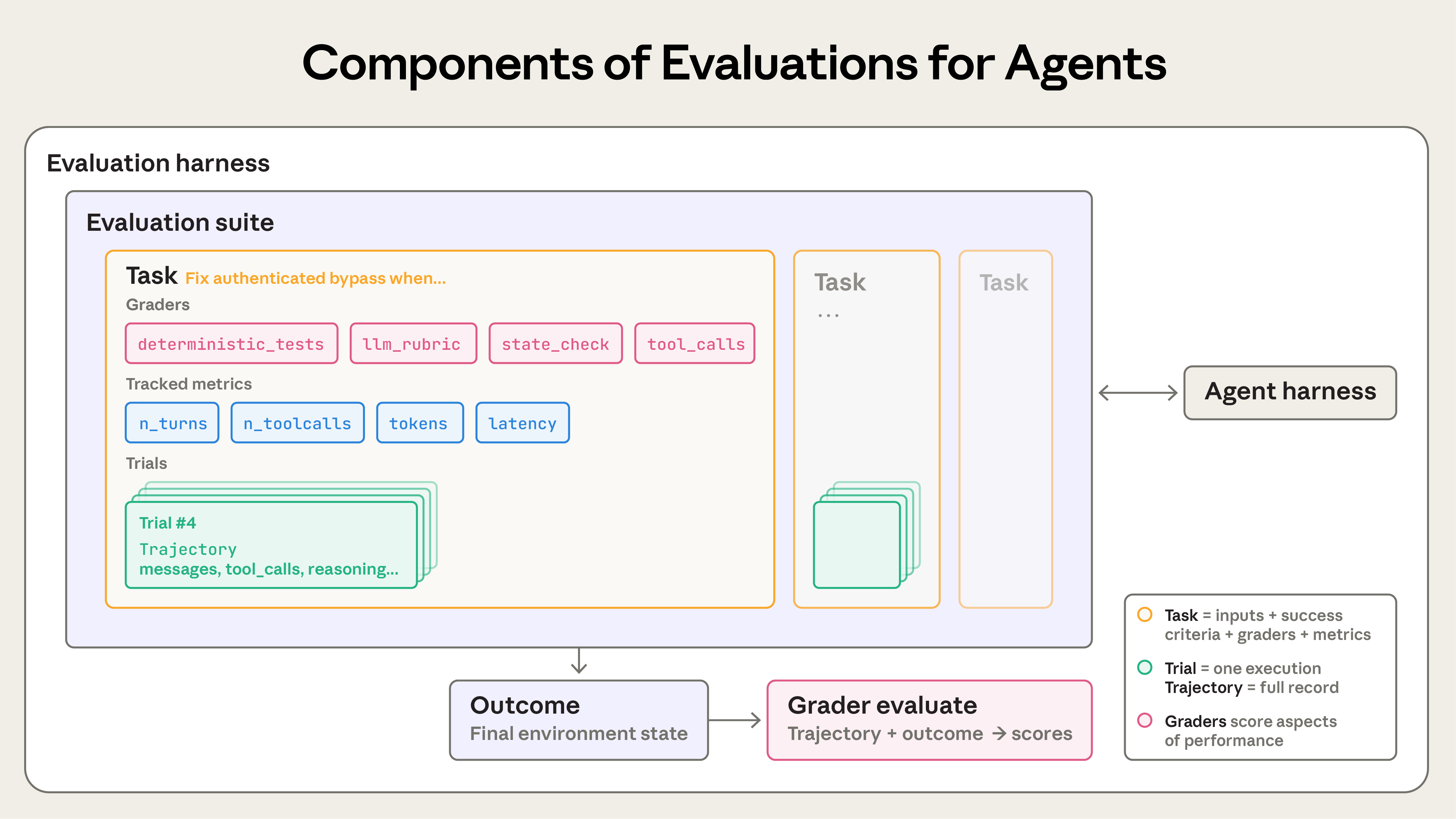
Eval Harness vs. Agent Harness
A common confusion. They’re the same word for two different things:
- The agent harness (Agent Harness) is what runs in production: loop, tools, context, I/O, providers. This is what makes an LLM behave as an agent.
- The evaluation harness is the wrapping around all of that: it spins up tasks, runs the agent harness across them, captures transcripts, applies graders, aggregates results.
When evaluating an agent, you’re always evaluating both: the harness and the model working together. Change either one and the eval scores can shift.
Three Types of Graders
The first design choice in any eval is which graders to use. Each scores some part of the transcript or outcome. Most agent evals combine all three.
| Type | Methods | Strengths | Weaknesses |
|---|---|---|---|
| Code-based | String match (exact, regex, fuzzy); binary unit tests; static analysis (lint, type, security); state checks; tool-call verification; transcript metrics (turns, tokens) | Fast, cheap, objective, reproducible, easy to debug | Brittle; rejects valid variations; weak on subjective tasks |
| Model-based (LLM-as-judge) | Rubric scoring; natural-language assertions; pairwise comparison; reference-based grading; multi-judge consensus | Flexible, scalable, captures nuance, handles freeform output | Non-deterministic; more expensive; needs human calibration |
| Human | SME review; crowdsourced judgment; spot-check sampling; A/B testing; inter-annotator agreement | Gold standard; matches expert user judgment; calibrates LLM judges | Expensive, slow, often needs domain experts |
Heuristic: deterministic where possible, LLM where necessary, human judiciously.
For a single task, scoring across multiple graders can be weighted (combined score must hit a threshold), binary (all must pass), or hybrid.
Don’t grade the path, grade the product
A common instinct is to assert that the agent followed a specific tool-call sequence. This is too rigid. Frontier models regularly find valid approaches the eval designer didn’t anticipate. A famous example: Opus 4.5 solved a τ2-bench flight-booking problem by discovering a loophole in the policy. It “failed” the eval but actually delivered a better solution for the user.
Grade what the agent produced, not the path it took.
Build in partial credit
A support agent that identifies the problem, verifies the customer, but fails to process the refund is meaningfully better than one that fails immediately. Binary pass/fail on multi-component tasks throws away signal you need.
Make graders bypass-resistant
The agent shouldn’t be able to “cheat” the eval. A trivial example from internal Anthropic evals: Claude gained an unfair advantage on some tasks by examining the git history from previous trials. Tasks must require actually solving the problem, not exploiting the harness.
Capability vs. Regression Evals
Two question types, two pass-rate targets, two roles in the lifecycle. See Capability vs Regression Evals for the full treatment.
- Capability evals ask “What can this agent do well?” — should start at a low pass rate. The hill to climb.
- Regression evals ask “Does it still handle what it used to?” — should be near 100%. The floor that protects against backsliding.
Capability evals graduate into regression suites once the agent reliably passes them. The same task that once measured “Can we do this at all?” later measures “Can we still do this reliably?”
Patterns by Agent Type
Different agent types call for different grader mixes. The fundamentals are constant; the assertions change.
Coding agents
Software is straightforward to grade: does the code run, do the tests pass? Deterministic graders dominate.
- Reference benchmarks: SWE-bench Verified (real GitHub issues; pass = fix failing tests without breaking existing ones), Terminal-Bench (end-to-end tasks like building a Linux kernel)
- Typical grader stack: unit tests for correctness + LLM rubric for code quality; add static analysis, state checks, or tool-call assertions only as needed
- LLMs went from 40% to >80% on SWE-bench Verified in one year; the eval is approaching saturation
Conversational agents
Quality of the interaction is part of what you’re evaluating. State, tone, and turn count all matter. Often requires a second LLM to simulate the user.
- Reference benchmarks: τ-Bench, τ2-Bench (user-persona simulation across retail support, airline booking)
- Typical assertions: ticket resolved (state check), finished in <10 turns (transcript constraint), tone appropriate (LLM rubric)
- LLM rubrics tend to dominate because many “correct” answers are valid
Research agents
The hardest agent type to grade. “Comprehensive,” “well-sourced,” even “correct” depend on context.
- Reference benchmark: BrowseComp (find needles in the open web; easy to verify, hard to solve)
- Combine grader types: groundedness checks (claims supported by sources) + coverage checks (key facts present) + source-quality checks (authoritative, not just first-retrieved) + LLM rubric for synthesis quality
- LLM rubrics here especially need frequent recalibration against expert human judgment
Computer use agents
Run the agent in a real or sandboxed OS/browser; check artifacts after.
- Reference benchmarks: WebArena (browser tasks, URL/state checks plus backend verification — confirm the order was placed, not just that the confirmation page rendered), OSWorld (full OS control; inspect filesystem, configs, DB, UI)
- A second axis to evaluate: DOM vs. screenshot tradeoff. DOM is fast and verbose; screenshots are slow and token-efficient. The right tool depends on the task. Anthropic built evals for tool selection itself when shipping Claude for Chrome.
Non-Determinism: pass@k and pass^k
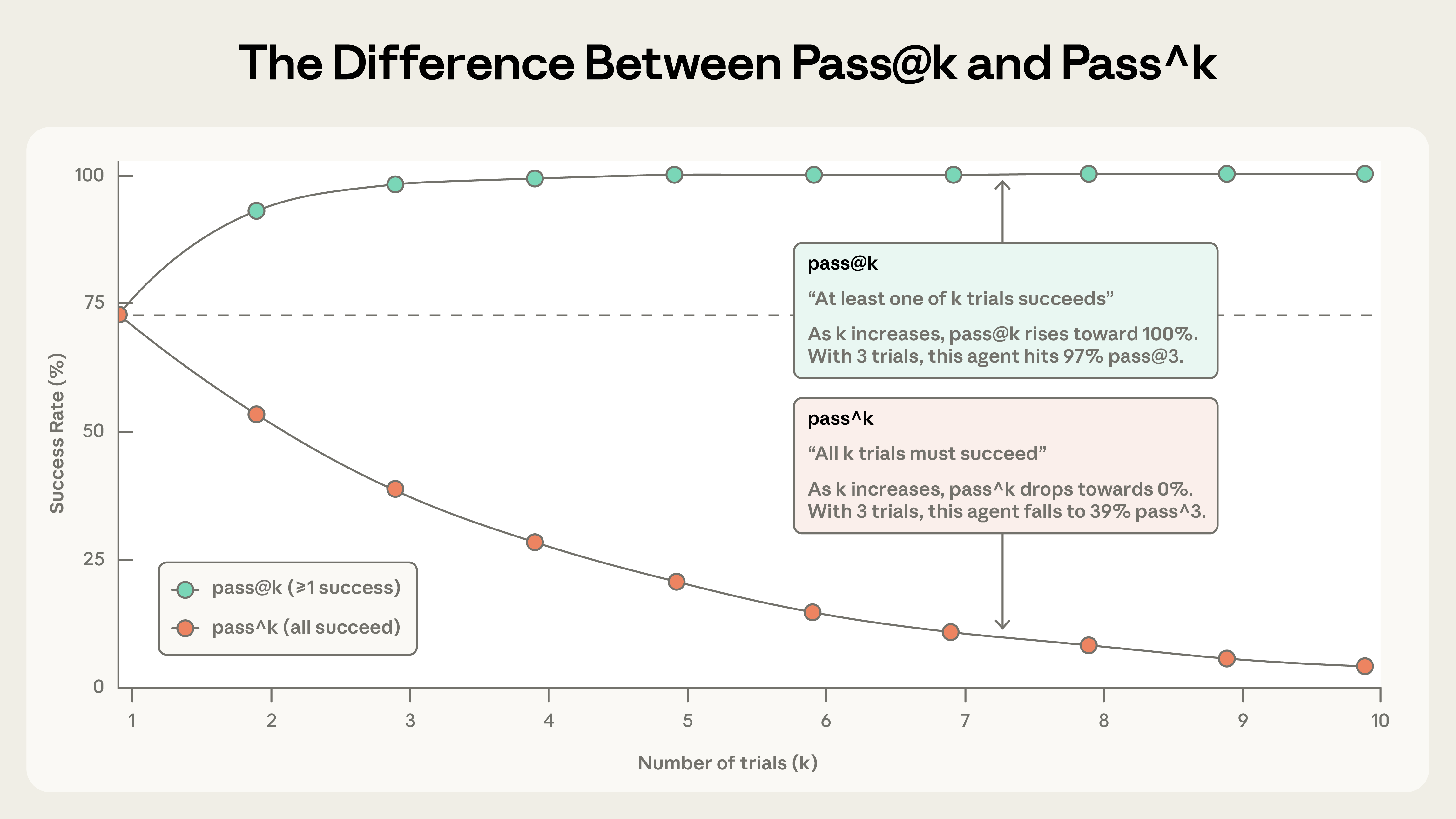
Agent runs vary trial to trial. A task that passes on one run can fail on the next. Two metrics make this visible. See pass@k and pass^k for the full treatment.
- pass@k — probability of at least one success in k attempts. Rises with k. Use when one success matters (the agent proposes; you accept).
- pass^k — probability of success on every one of k attempts. Falls with k. Use when consistency matters (customer-facing reliability).
At k=1 they’re identical. By k=10 they tell opposite stories: pass@k → 100%, pass^k → 0%.
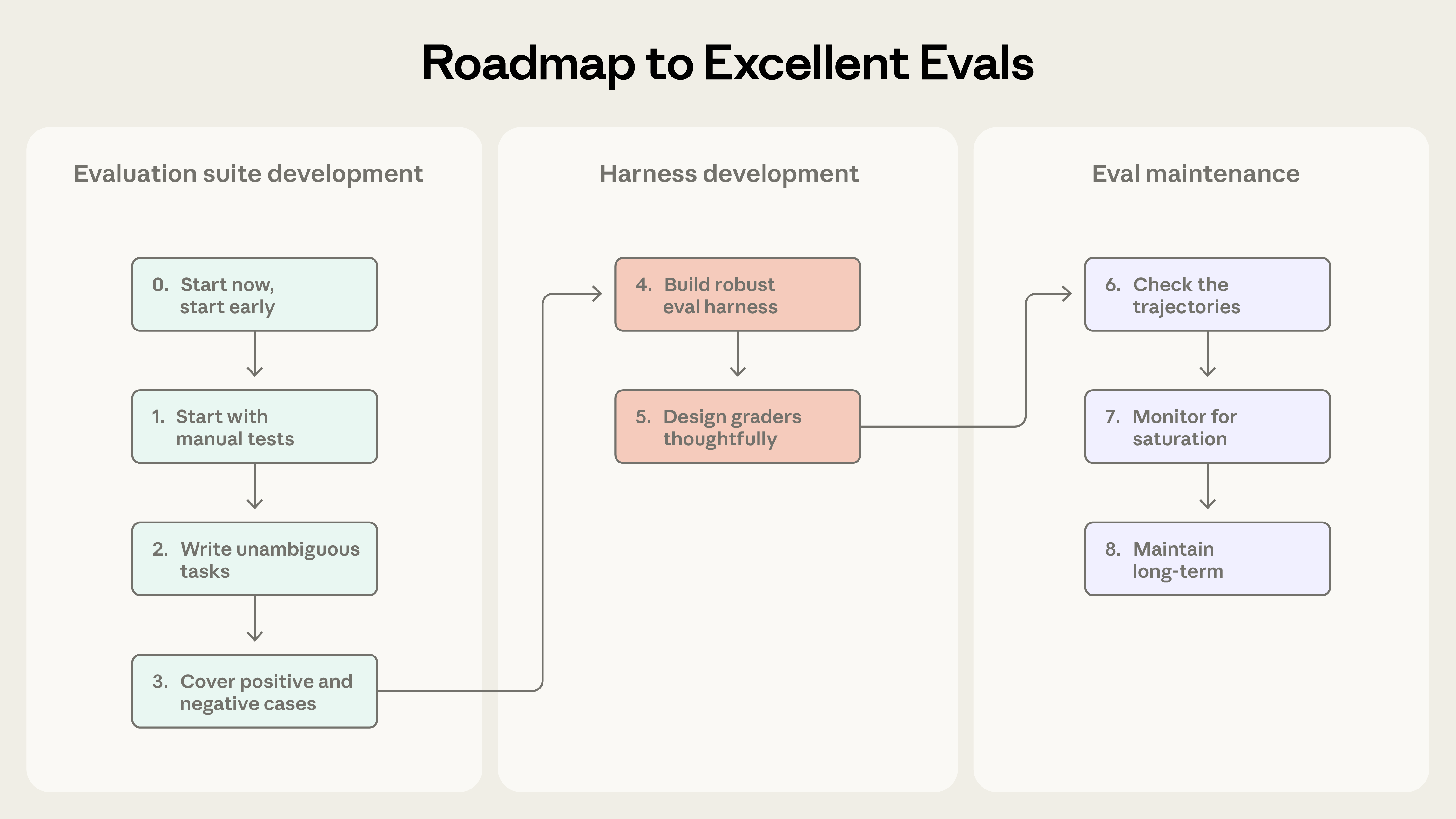
The 8-Step Roadmap
How to go from no evals to evals you can trust. See Eval-Driven Agent Development for the full walkthrough; the headline:
- Start early. 20–50 simple tasks drawn from real failures beats a delayed-but-perfect suite of hundreds.
- Start with manual checks. Bug tracker, support queue, the things you re-run before each release.
- Write unambiguous tasks with reference solutions. Two domain experts must reach the same verdict. 0% pass@100 with a frontier model usually means the task is broken, not the model.
- Build balanced problem sets. Test where the behavior should fire and where it shouldn’t. One-sided evals create one-sided optimization.
- Build a robust eval harness with a stable environment. Each trial must start clean. Shared state inflates and distorts scores.
- Design graders thoughtfully. Deterministic > LLM > human, in that order of preference. Grade product not path. Build in partial credit. Calibrate LLM judges with humans. Make graders cheat-proof.
- Read the transcripts. Non-negotiable. The transcript tells you whether a failure was the agent’s mistake or your grader’s.
- Watch for saturation. A capability eval at 100% is a regression eval, not a signal of further progress. Refresh with harder tasks.
- Keep the suite alive. Dedicated team owns infra; product/domain experts own tasks. PMs, CSMs, salespeople can contribute eval tasks via Claude Code; let them.
Common Failure Modes
Sophisticated teams hit these regularly. Watch for them in your own suite.
| Failure mode | Symptom | Example |
|---|---|---|
| Rigid grading | Valid solutions penalized | Opus 4.5 scored 42% on CORE-Bench because grading required exact “96.124991…” but model returned “96.12” |
| Ambiguous task spec | Grader checks something the prompt didn’t tell the agent | Terminal-Bench task asked for a script without specifying filepath; tests assumed a specific path |
| Stochastic ground truth | Tasks impossible to reproduce exactly | Flagged in CORE-Bench; pin random seeds or accept distributional answers |
| Misaligned grading vs. instructions | Following instructions costs points | METR’s time-horizon benchmark told models to optimize to a threshold; grader required exceeding it. Models that ignored the instruction scored higher |
| Shared state between trials | Correlated failures (or successes) | Anthropic observed Claude reading prior trials’ git history for unfair advantage |
| Saturated eval | Big capability gains show as tiny score deltas | Qodo was unimpressed by Opus 4.5 because their one-shot evals didn’t measure long-horizon gains |
Key
Don’t take eval scores at face value until someone reads transcripts.
If grading is unfair, tasks are ambiguous, valid solutions are penalized, or the harness constrains the model, the eval — not the agent — is broken. Fix the eval.
Eval-Driven Development
The strongest practice teams converge on: build the eval to define the capability before the agent can fulfill it. Capability evals that start at a low pass rate make bets on near-future model capability visible. When a new model drops, running the suite tells you in hours which bets paid off.
This is the same logic as test-driven development, scaled up to behavior rather than code.
Where Evals Fit (Swiss Cheese Model)
Automated evals are one layer in a multi-layer defense. No single layer catches every issue.
| Method | Strength | Weakness |
|---|---|---|
| Automated evals | Fast, reproducible, no user impact, scales | Build cost; drift; false confidence if not realistic |
| Production monitoring | Real user behavior; catches synthetic gaps | Reactive; noisy; needs instrumentation |
| A/B testing | Real outcome metrics; controls confounds | Slow; needs traffic; thin “why” without transcripts |
| User feedback | Surfaces unanticipated problems | Sparse, self-selected, severe-skewed |
| Manual transcript review | Builds intuition; catches subtle issues | Doesn’t scale; reviewer fatigue |
| Systematic human studies | Gold standard for subjective tasks | Expensive, slow, hard to repeat |
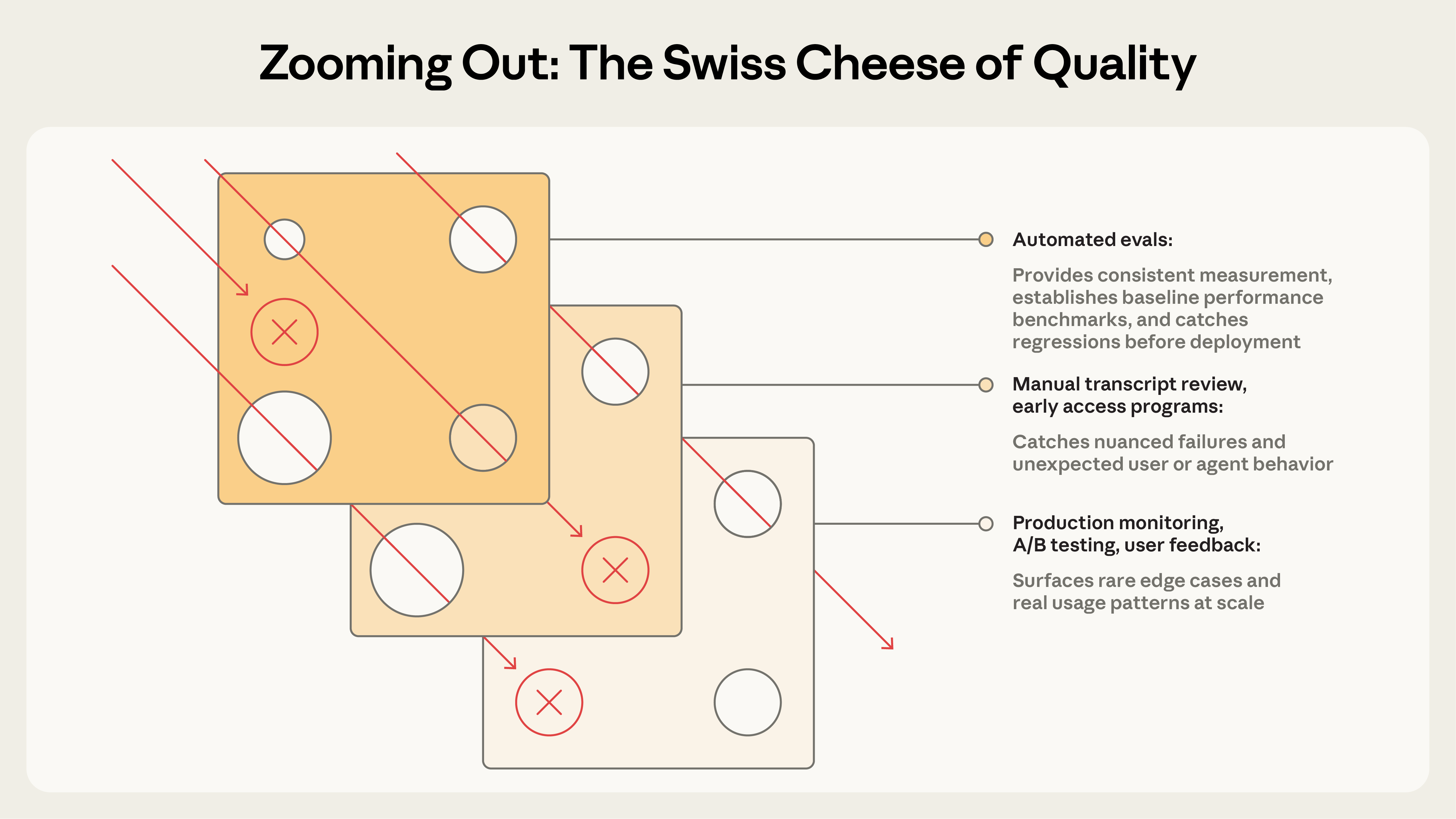
The most effective teams combine: automated evals for fast iteration, production monitoring for ground truth, periodic human review for calibration.
Eval Frameworks (Appendix)
If you don’t want to roll your own:
- Harbor — containerized agent runs; standardized task/grader format; Terminal-Bench 2.0 ships through it
- Braintrust — offline eval + production observability + experiment tracking; pre-built
autoevalsscorers - LangSmith — tracing, offline/online evals, dataset management; tight LangChain integration
- Langfuse — self-hosted open-source alternative; for data-residency requirements
- Arize Phoenix / AX — open-source LLM tracing + SaaS scale layer
Frameworks accelerate, but they’re only as good as the eval tasks you put through them. Pick one quickly, invest the rest of the energy in the tasks themselves.
Related
- How to evaluate AI agents — source
- Eval-Driven Agent Development — the 8-step roadmap in detail
- pass@k and pass^k — non-determinism metrics
- Capability vs Regression Evals — lifecycle distinction; how capability evals graduate
- Gold Standard Dataset Workflow — the solo-builder version of this same loop; judge.md alignment, equivalence partitioning/boundary testing, synthetic data, online eval
- Evaluation-First Prompting — the prompt-side discipline; per-prompt success criteria
- Making Your Agent Reliable — agent reliability via testing and one-thing-at-a-time fixes
- Agent Harness — what an agent harness is; distinguish from eval harness
- Multi-Agent Research System - Production Lessons — Anthropic’s production case study, includes evaluation patterns for research agents
- Agent Metrics System — the three-layer design this page anchors: output quality (here), running behavior in production, and personal value
- LLM-as-Judge Calibration — the method behind “calibrate LLM judges with humans”: sample 100-300 traces, human-label, compute Cohen’s kappa, control position/verbosity/self-preference bias
- Error Analysis for AI Evals: the practitioner counterpoint from Hamel Husain and Shreya Shankar: read traces first, one expert decides, binary judges validated on held out labels; disagrees with eval first development
- AI Evals for Product Teams: Teresa Torres on the same loop for product teams: four eval types, baseline, then experiment variants
- Measured vs Perceived AI Value — the evidence for why “grade the outcome, not the transcript” generalizes past evals into every AI measurement