Key Stills
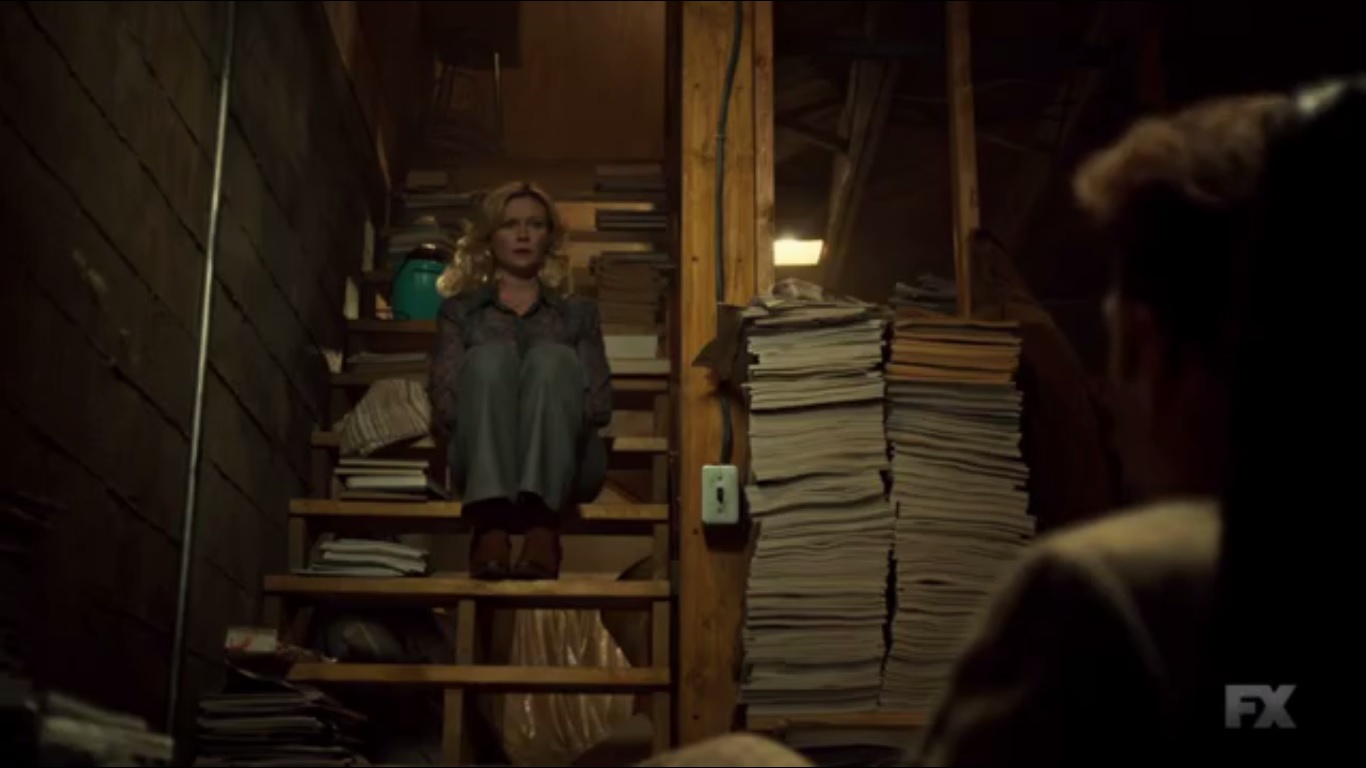
Peggy hallucinates a British man named Albert in the place of the tied-up Dodd. Albert asks her if she has “actualized fully.” The episode’s title figure made literal — the bird-superior surfaces in the room.
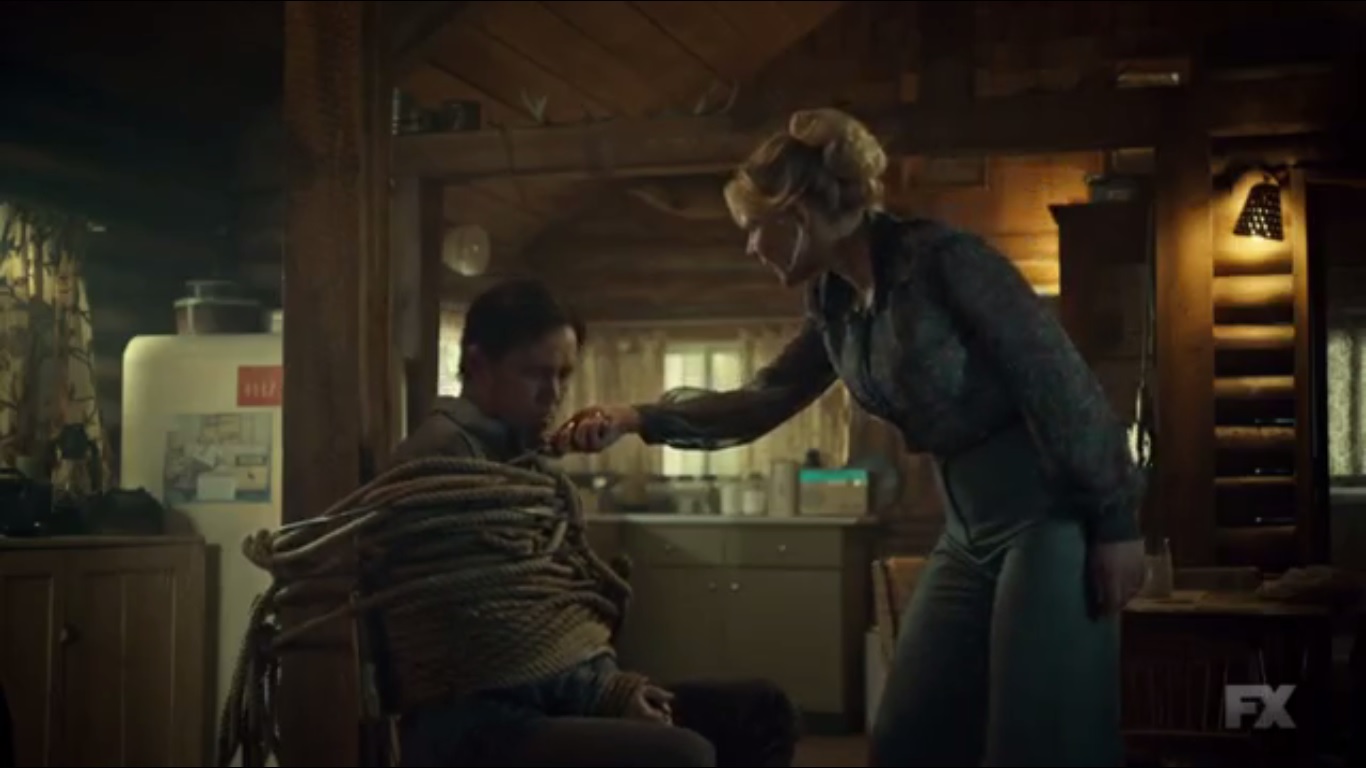
Peggy needs a knife. The seminars, the magazines, the steering of Ed — all the surface forms of her actualization arrive at this hand and this object.
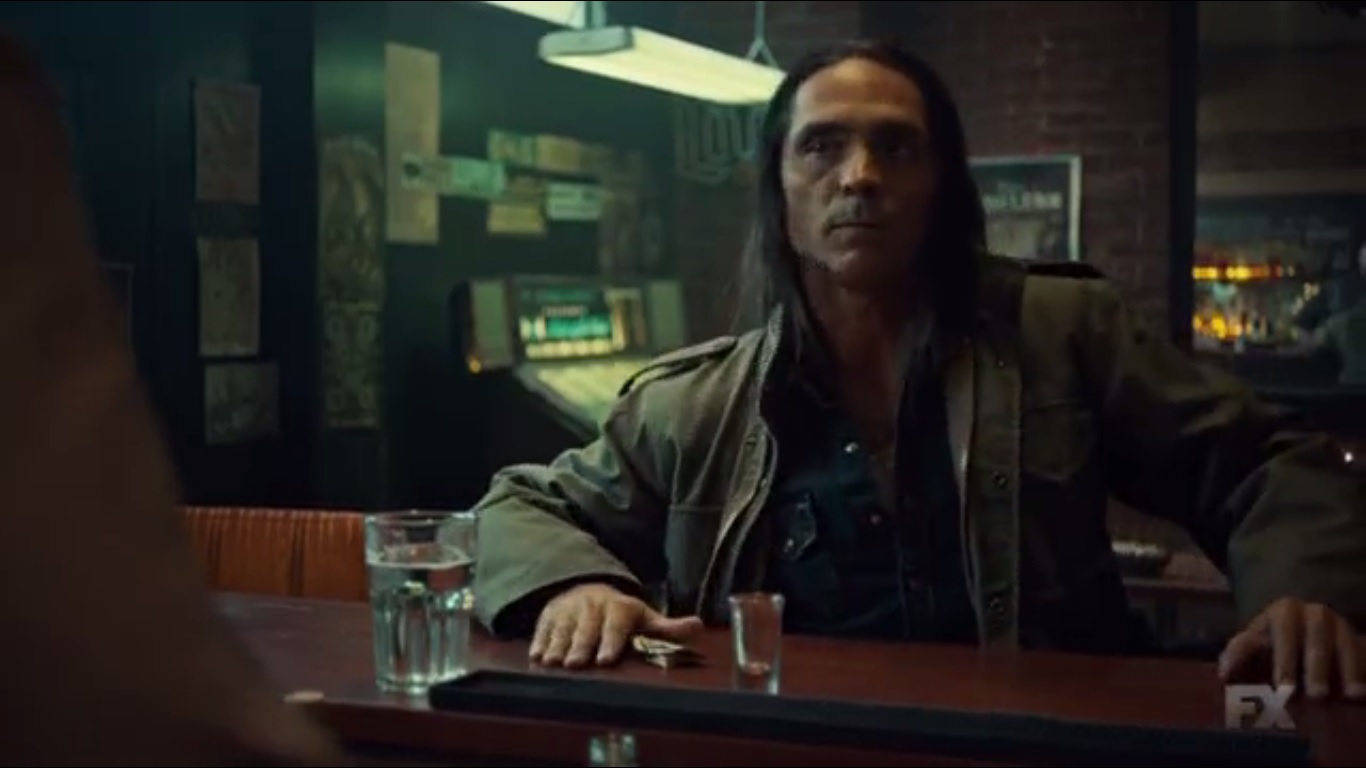
Hanzee, racially insulted in a small-town bar, pays for his drink with exact change. The next moment is the moment he stops being the Gerhardts’ man.
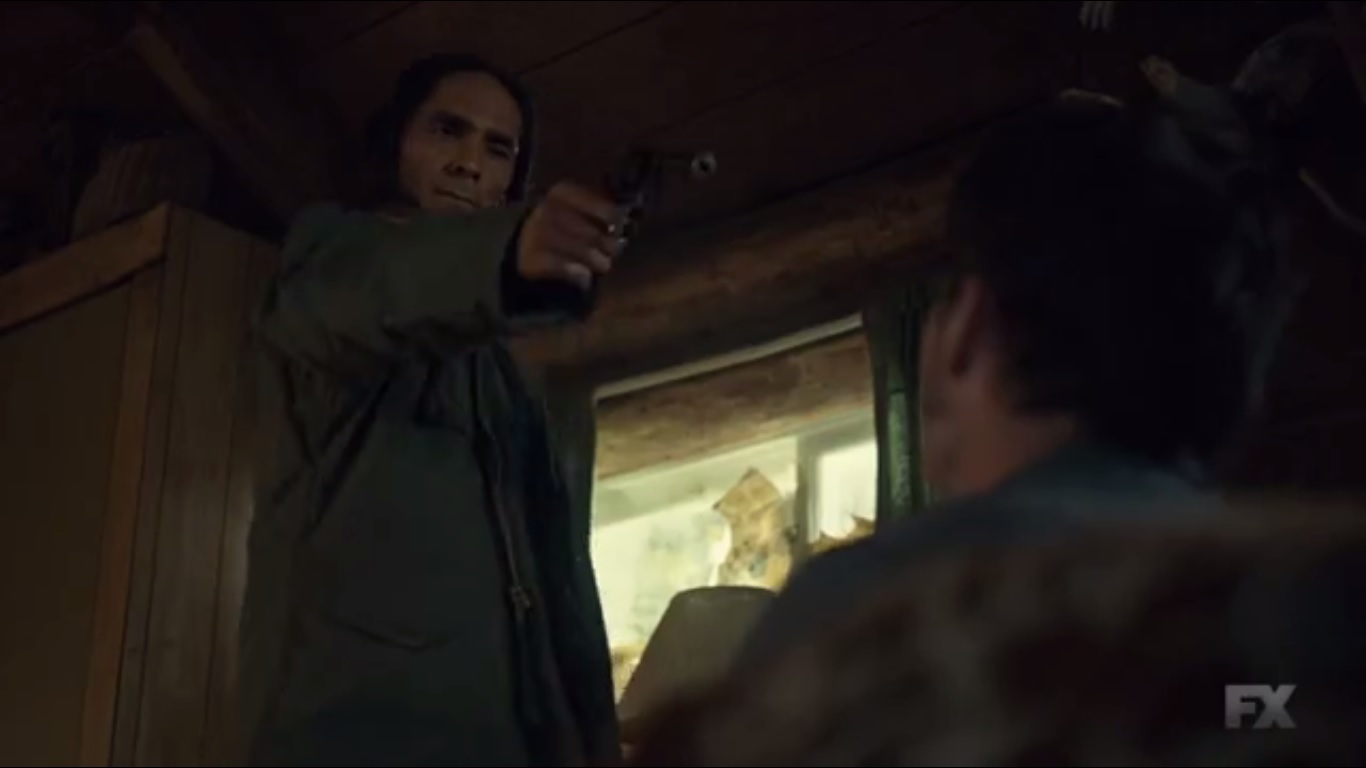
Hanzee shoots Dodd in the head as Dodd is about to kill Peggy. The break from the family is performed as an act of mercy toward a stranger.
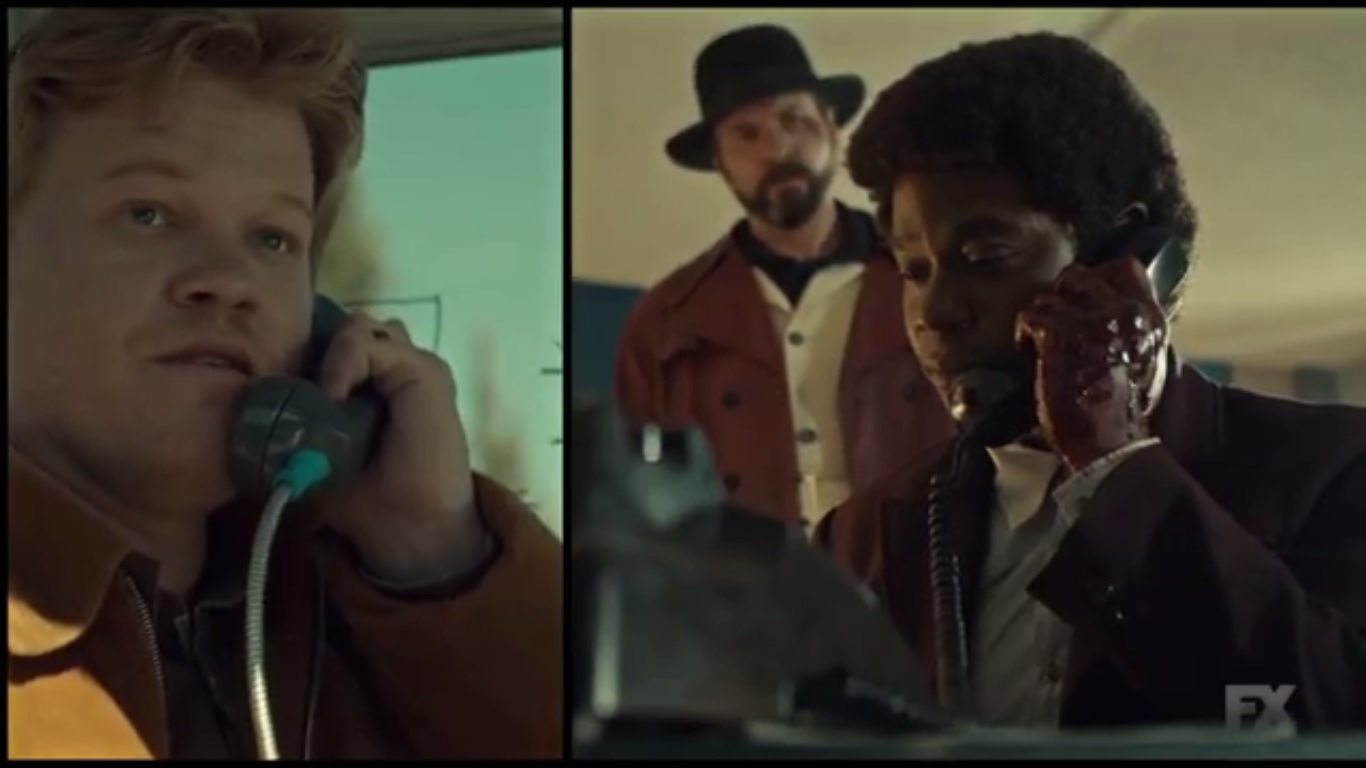
Ed accepts the title “Butcher of Luverne” — the partial, defended self-recognition of a man who is still trying, against all evidence, to remain the husband he was.
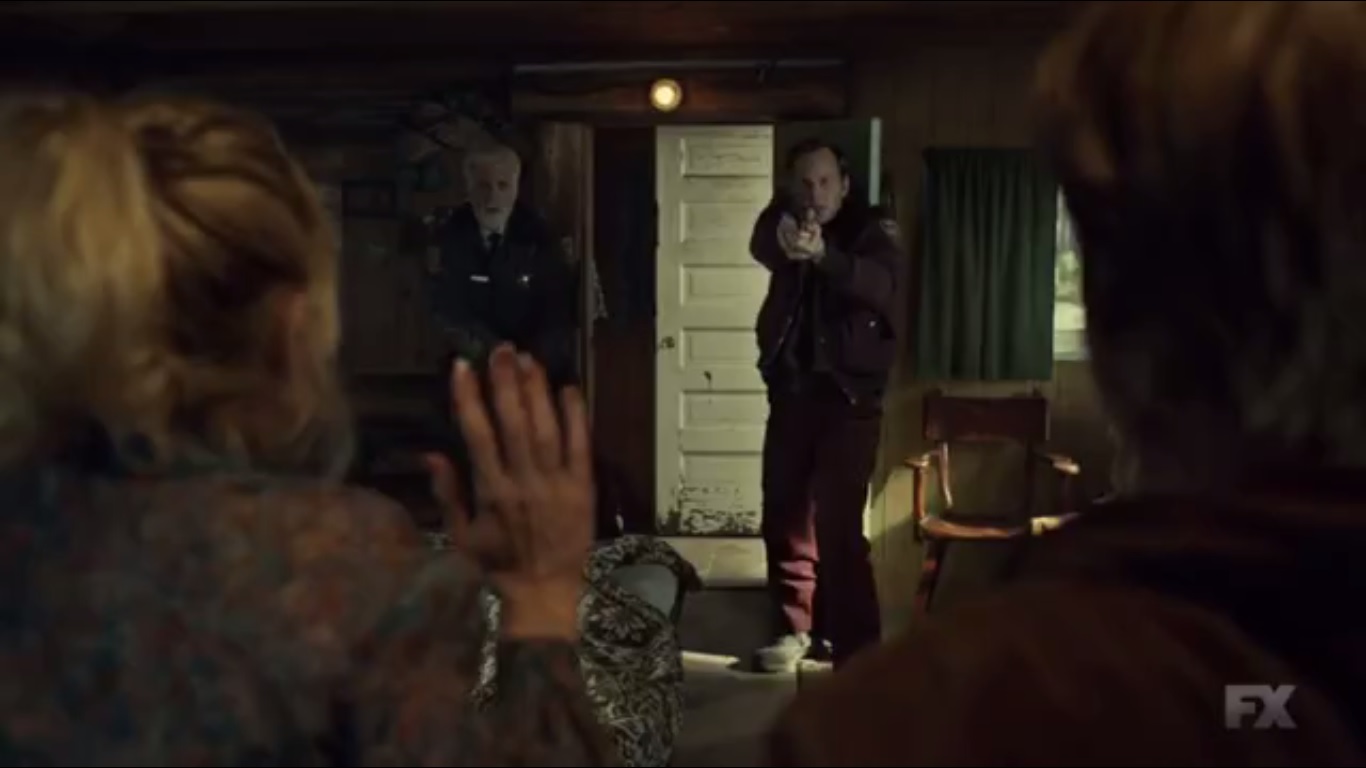
Lou and Hank corner Ed and Peggy. The lawmen, stripped of jurisdiction in E07, have returned to the case as themselves — without institutional cover.
Episode Summary
Ed and Peggy hide in a Motor Motel cabin with the captured Dodd Gerhardt tied to a chair. Ed leaves to negotiate with Mike Milligan; Peggy, alone with Dodd, hallucinates a soft-spoken British man named Albert who asks her if she has “actualized fully.” Peggy tases Dodd, stabs him, watches a Reagan war film on the television, and misses Dodd slipping his ropes. Hanzee, hunting the Blomquists, is humiliated in a small-town bar, kills the two men who insulted him, and kills the two cops who respond. He visits Constance, Peggy’s Lifespring friend, who calls Peggy and is then killed off-screen. Hanzee finds the cabin. Dodd, freed, is about to kill Peggy when Hanzee shoots Dodd in the head — the season’s break-point. Lou and Hank arrive moments after Hanzee leaves and corner Ed and Peggy. The episode ends on the Blomquists in custody and Hanzee gone.
The Title
Where it comes from. “Loplop” comes from Max Ernst, the German-French Surrealist painter (1891–1976), one of the founding figures of Dada and Surrealism. Beginning around 1929–1930, Ernst invented an alter ego he called Loplop, also known as the Bird Superior (l’Oiseau Supérieur). Loplop is a bird-headed figure — sometimes a stylized human with a bird’s head, sometimes a bird with human attributes — who appears in dozens of Ernst’s collages, paintings, and books. He is most often shown presenting something: holding up another image, framing it, gesturing toward it. Ernst described Loplop as his “private phantom attached to my person,” a personal totem that made his interior life visible inside his art. Loplop is not a character. Loplop is the figure of the artist’s hidden self made into an object you can see.
Where it lands in the episode. Two scenes carry the frame, and the season’s logic depends on both:
- Peggy hallucinates Albert. Alone with the tied-up Dodd, Peggy sees in his place a soft-spoken British man named Albert (Mackenzie Gray) who asks her, in the seminar’s exact register, whether she has “actualized fully” — whether she is “thinking or being.” This is the title rendered as a scene. Peggy’s hidden self, the actualization-figure she has been chasing for seven episodes, surfaces in the room as a person and addresses her directly. Loplop is in the cabin. The Bird Superior asks Peggy if she has done what she said she was going to do.
- Hanzee in the bar. Hanzee is racially insulted by two men, and pays for his drink with exact change — quiet, controlled, the lifelong practice of keeping his interior invisible. The moment he steps outside and shoots them, his Loplop surfaces too. Whatever Hanzee has been holding inside for the entire season, performing as the Gerhardts’ tracker, becomes visible as action.
What the title is doing. Ernst’s Loplop is the artist’s hidden self surfacing as form. Fargo S02E08 is the episode of the season in which the hidden selves of two characters surface as form. Peggy’s Loplop is a knife and a hallucination of Albert. Hanzee’s Loplop is a gun used outside its assignment. The title’s bleak edge is that the hidden selves, when they surface, are not the selves the characters were hoping for. Peggy’s actualized self is a killer. Hanzee’s free self is a man with no country. The Bird Superior is supposed to be the artist’s higher self. In Fargo, the higher self is whatever was actually inside, and what was actually inside is mostly dangerous.
Key Insights
Self-recognition is the cutting of bindings. The episode’s core argument, which Quang named precisely: “When they find out what they actually are, nothing binds them. They do anything they want, with what they have.” Peggy and Hanzee both reach the moment of self-recognition in this episode and the same thing happens to both of them — the bindings come off. Peggy is no longer Ed’s project, the Lifespring student, the manageable wife. She is a woman with a knife in a cabin. Hanzee is no longer the Gerhardts’ tracker, the loyal weapon, the man who gets pointed at problems. He is a man with a gun and no employer. The freedom is real. What stays after the bindings come off is what was always there. Peggy had a knife inside her the whole season. Hanzee had a gun. The episode makes both visible.
Ordinary humanity and self-knowledge are incompatible. Building on the recognition reading: most people, as Quang noted, do not reach self-recognition because most people choose the path of least pain or follow the crowd. The bindings — family, social role, the self-image you have been performing — are exactly what daily life is made of. Self-recognition costs you the bindings. Therefore, on this reading, the price of being human in the ordinary, lovable, “I love my wife and want the butcher shop” sense is precisely not knowing what you actually are. Ed’s refusal to recognize himself is not weakness; it is the structural condition of being able to love Peggy at all. This is a hard claim about the world. The show does not flinch from it. The episode lets Ed accept the comic title “Butcher of Luverne” as a deflection — a way to acknowledge his violence without confronting it — because the full confrontation would cost him the marriage.
Lou as the impossible exception. If the rule is recognition or ordinary humanity, not both, then Lou is the unicorn the show holds up against the rule. Lou appears to know what he is — morally clear, sees through Reagan, sees through Mike Milligan, sees through the institutional politics of E07 — and he remains capable of ordinary love. He sits with the dying Betsy. He drives home to his daughter. He honors Hank. He has not transformed into a rhinoceros, has not become Peggy or Hanzee, has not refused recognition the way Ed has. He is the fourth position. The season’s bleakest argument, given this exception, is that the country was offered Lou and chose Reagan: the man performing the cowboy myth without its cost over the man actually paying the cost. Lou is the impossible figure. The country did not take him.
Peggy’s Loplop is Albert; Albert is the seminar’s voice. The hallucination of the British man is one of the season’s most carefully constructed scenes. He is calm, soft, well-spoken — the sound of self-help and actualization, the seminar made flesh. His questions (“Have you actualized fully? Are you thinking or being?”) are the seminar’s catechism. The fact that Peggy hallucinates him while torturing a tied-up man is the show’s harshest commentary on the actualization industry. The voice that has been promising Peggy a higher self for the entire season is talking to her while she stabs a captive. Albert is not horrified. Albert is encouraging. He is a Loplop who has come to certify her actualization, and the actualization, on inspection, is the act she is committing.
Hanzee’s bar scene is the season’s most precise portrait of accumulated humiliation becoming agency. Hanzee orders a drink. The bartender slow-walks him. Two men insult him for being Native American. Hanzee pays with exact change — the discipline of decades, the practice of not being the visible thing. Then he steps outside and, with no escalation, no warning, no monologue, shoots them. The episode is doing what the season has been preparing for since E03: showing us the interior of a man we have been reading from the outside. The choice the show makes is to not give us a speech. Hanzee does not explain himself. He has been explaining himself, in his head, his entire life. This is the moment he stops needing to.
Hanzee shoots Dodd, and the act is for Peggy, not for Hanzee. When Hanzee fires the shot that kills Dodd, Dodd is about to kill Peggy. This matters. Hanzee’s break from the family is not framed as ambition or revenge. It is framed as an act on behalf of someone he has no relationship to, against the man who employed him, in a moment when the family’s discipline (Dodd killing the woman who took his hostage) would have been the family’s logic. Hanzee chooses the stranger over the family. The show is making its quietest claim about what self-recognition actually frees you to do: choose your own ethic, even when the ethic does not match the role you have spent your life playing.
Peggy watches a Reagan war film while Dodd escapes. The motel television is playing Operation Eagle’s Nest (a Reagan-Era WWII film standing in for the season’s recurring myth-machine). Peggy is absorbed in it. Dodd slips his ropes and prepares to kill her. The image is the season’s whole argument compressed into a single shot: the country watches the cowboy myth on screen while the actual violence prepares itself in the room. Peggy is, for that moment, the country — drawn by the performance of heroism and missing the real situation. The fact that she survives is luck (Hanzee), not vigilance.
Ed accepts “Butcher of Luverne” because the comic title lets him avoid the real one. Late in the episode, Ed is told the press is calling him “the Butcher of Luverne.” He accepts the name. The acceptance is partial, defended, almost relieved — if I am only the Butcher of Luverne, I can still be Ed. The nickname is a costume. It lets him admit something violent without admitting what he has actually become. This is Ed’s version of self-recognition: just enough to let him keep going, never enough to let the marriage end. The refusal Quang named is performed even here, in the moment of apparent acknowledgement.
Lou and Hank’s arrival as the lawmen returning without institutional cover. Stripped of jurisdiction by Chief Gibson in E07, Lou and Hank corner the Blomquists in this episode anyway. They are now operating as themselves, not as the system. The corner is gentler than it would have been a week earlier — Lou warns rather than threatens, even at the gun-point of the moment. The lawmen succession we have read across the season is now operating in private. The institutions have left. The men have not.
Character Readings
Peggy Blomquist — Reaches the moment Quang named: self-recognition. The seminar-self surfaces as Albert. The hidden character surfaces as a knife in a tied-up man. The arc that began with her dissociation in E01 and continued as her steering of Ed through E03–E05 closes here: the steering was always toward this room. Peggy is, in this episode, more herself than at any prior point in the season, and the self that emerged is dangerous, focused, capable of stabbing without hesitation, and absorbed in a Reagan war film while a man slips his ropes behind her. Kirsten Dunst plays the recognition without any triumph; this is not Peggy’s becoming, this is Peggy’s exposure.
Hanzee Dent — Reaches the same moment, from a different direction. The decades of practiced invisibility, exact change, and quiet humiliation are spent in a single afternoon. Hanzee in this episode is the season’s most legible portrait of accumulated agency: the man who has been making his own decisions since E04 (the buckle), since E05 (when to deliver it), now makes the decision that takes him outside the Gerhardt structure entirely. The killing of Dodd is the structural break. He is no longer the family’s weapon. The episode does not tell us what he is yet. Quang’s read: he chose freedom, and he may have known the family was already ending.
Ed Blomquist — The only major character in this episode who actively refuses the recognition the others are reaching. He still believes he can negotiate his way out, still believes the marriage is the future, still believes the man who left Luverne with a body in a windshield is the same man he was. The acceptance of “Butcher of Luverne” is the maximum recognition Ed will allow himself. Quang’s read of Ed: the refusal is what keeps him human. Loving Peggy in the way Ed loves her requires not seeing what she has become — and not seeing what he has become with her. The refusal is structural. Without it, the marriage cannot exist. With it, Ed is doomed.
Dodd Gerhardt — Tied to a chair for most of the episode. Calls Peggy a “weak-willed flower.” Says, before he dies, that “Satan is a woman.” This is the patriarchal worldview crystallized into a single sentence. Dodd dies inside that sentence, killed by Hanzee on behalf of the woman he just called Satan, and the irony is not arbitrary. Dodd’s worldview is what the season has been arguing against from the cold open of E04 onward. It is fitting that the worldview’s final words name his own murderer’s motive without recognizing it.
Lou Solverson — Returns to the case as a private moral agent without institutional cover. The “softness” we have been tracking across the season is, in this episode, the same softness applied at a higher cost: Lou is no longer being “soft” against the system’s grain because the system has thrown him out. He is being soft as the only available mode. Quang’s reading at the start of this conversation makes Lou the impossible figure — the man who knows what he is and loves ordinarily. The episode confirms this by letting him appear without ceremony; he just shows up, calm, aimed at saving the people he is also arresting.
Hank Larsson — Beside Lou. The older lawman continues the work of E07 — present, patient, the steadier register. The two men’s complementary work, which we read in E06 as the lawmen succession that works, is now running entirely off the books. The institutions have left. The practice continues.
Constance Heck — Peggy’s Lifespring friend, killed off-screen by Hanzee. The Lifespring world that has been Peggy’s promise of a future self is liquidated in the same episode that the seminar’s voice (Albert) appears as a hallucination. The two scenes are paired. The seminar speaks; the seminar’s flesh-and-blood embodiment dies. The actualization arc is closed by both surrealist appearance and physical removal. Peggy’s “future” no longer has a habitat in the world.
Albert (the British man) — Not a character in the standard sense. The hallucination Peggy projects onto Dodd’s body is the season’s clearest staging of Loplop: the artist’s hidden self-figure surfacing inside the work to present what is really being made. Albert is calm, encouraging, philosophical. He is, in form, exactly what Peggy has been longing to become. In content, he is presiding over her stabbing of a captive. The character’s existence is the show’s harshest joke about the actualization industry: the higher self the seminar promised arrives and turns out to be encouraging exactly what Peggy is doing.
Mike Milligan — Off-page mostly in this episode after his E07 reversal. The trade with Ed is suspended. The Gerhardt war is now consuming itself without Mike needing to do anything; he is, structurally, waiting.
Symbols & Motifs
- The cabin — interior space made absolute; the bottle episode as form mirroring the season’s narrowing to interiority; the room where hidden selves surface
- Albert — the Loplop figure literalized; the seminar’s voice arriving in person to certify the actualization the audience can see is monstrous
- The knife — Peggy’s hidden character made physical; the object that was always going to surface
- Exact change in the bar — Hanzee’s lifelong discipline of keeping the interior invisible, performed one last time in the second before the discipline breaks
- The Reagan war film on the motel TV — the country watching the cowboy myth on screen while the actual violence prepares itself in the room; Peggy as the country, drawn by performance, missing the real situation
- The pillowcase over Dodd’s head — the man who in 1951 was handed a gun and made into a killer is now reduced to a hooded captive; the founding violence of the family undone in a motel
- “Satan is a woman” — the patriarchal worldview crystallized, dying inside its own sentence, killed by a man acting on behalf of the woman it just named the devil
- “Butcher of Luverne” — the comic name as costume; partial recognition as the device that lets Ed avoid full recognition
Open Questions
- Hanzee has broken from the Gerhardts. He is a man with a gun and no country. What does his next twelve hours look like, and does the season let us see him deciding, or does his agency become opaque again?
- Peggy has crossed into the killer she always was. Does the rest of the season let her stay there, or is there still a path back to the seminar’s promise?
- Ed has accepted “Butcher of Luverne” but refused the deeper recognition. The marriage is now operating on a thinning fiction. When does the fiction break, and which of them breaks it?
- Lou and Hank have cornered the Blomquists. The system has thrown them off the case. Whose authority is now arresting Ed and Peggy?
- Mike Milligan is waiting. The Gerhardts are dismantling themselves. When does Mike re-enter the season, and is there anyone left for him to negotiate with?
- The Reagan film on the motel television is the most explicit return to the season’s American-myth thread since E05. Does the season let the myth-machine into the climactic episodes, or was this its last appearance before the Sioux Falls confrontation?
- Hanzee killed Constance, the Lifespring friend. The actualization arc has been physically liquidated as well as surreally hallucinated. Is the season closing Peggy’s “future-self” plot, or is there one more move?
Conversation
Q: Four threads — the title (Loplop / Ernst), Peggy and Dodd in the cabin, Hanzee at the cabin, Ed without Peggy.
Quang: This episode enables the real truth that Peggy and Hanzee start recognizing themselves. To live with what they are. They don’t have to doubt and try anything they don’t want.
Quang: Peggy has another character hidden in her normal behavior. She can be evil when someone insulted her. She stabbed the knife to Dodd without hesitate.
Quang: I surprised when he shot Dodd. He stopped following the order, he made up his mind and decided to choose freedom. That also means he does not choose Gerhardt family anymore. Maybe he knows that the family is coming to an end.
Quang: [On Ed] He is a normal person, a husband who loves the wife. He can think about the next action if the current strategy does not work. He just want to escape the killing, as soon as possible.
Claude: Held side by side, the four reads compose into something. Peggy and Hanzee both reach self-recognition; Ed actively refuses it and is the only character running away from the self the season has made of him. That is exactly what Ernst’s Loplop is — the artist’s “private phantom attached to my person,” the hidden self that surfaces in the work. Peggy’s Loplop surfaces. Hanzee’s Loplop surfaces. Ed’s stays underground because he is holding it down. The show treats Peggy’s and Hanzee’s recognition as a kind of freedom, but freedom for what? Peggy is now free to be a killer. Hanzee is now free to be a lone man with a gun in a country that does not recognize him. Their hidden characters are not, on inspection, gentle people. So is the show saying self-recognition is freedom, or is it saying self-recognition is the moment you find out what you actually are — and that the discovery is not necessarily good news?
Q: What does self-recognition reveal, and is Ed’s refusal a flaw or a virtue?
Quang: Self-recognition is the moment they find out what they actually are. And that moment, nothing binds them, they do anything they want, with what they have.
Quang: Ed’s refusal to recognize himself is only thing keeping him human. In my opinion, it’s difficult for a person to reach the state of self-recognition. People often follow the less pain choice, or the crowd’s behavior.
Claude: That sentence does a lot of work. The bindings — family, love, role, the self-image they were performing — are exactly what civilization is. Self-recognition is the cutting of those bindings, and what stays after is what they have. Peggy has a knife and a body. Hanzee has a gun and a country that does not recognize him. The freedom is real and terrifying because the bindings were the only restraint. And your second point sharpens the first: most people choose the less-pain path, so most people do not reach self-recognition — because the bindings are what the less-pain path is made of. So the show, on your reading, makes a hard claim: ordinary humanity and self-knowledge are incompatible. Ed’s refusal is not weakness. It is the structural condition of being able to love Peggy at all.
Claude: Now hold that against Lou. Lou is the season’s hardest character to place under your reading — he appears to know what he is, and he remains capable of ordinary love. He has not transformed into a rhinoceros and has not become Peggy or Hanzee. He is the impossible fourth position. If your reading is right, then Lou is the unicorn the show needs to make the trade-off visible. The country was offered Lou and chose Reagan: the man performing the cowboy myth without its cost over the man actually paying the cost. Lou is the impossible figure. The country did not take him.
Connected Pages
- Fargo S02 — season context, themes, character profiles
- Fargo S02E01 - Waiting for Dutch — E01: dissociation, the UFO, Reagan as cold open
- Fargo S02E02 - Before the Law — E02: Ed’s decision, the Kafka frame
- Fargo S02E03 - The Myth of Sisyphus — E03: Camus, four Sisyphus figures
- Fargo S02E04 - Fear and Trembling — E04: Otto’s pattern, Lou’s warning, the buckle
- Fargo S02E05 - The Gift of the Magi — E05: useless gifts, Reagan in the bathroom
- Fargo S02E06 - Rhinoceros — E06: Ionesco, Bear’s tragic patience, “being right is not the same as being on time”
- Fargo S02E07 - Did You Do This No You Did It — E07: the Borscht Belt recursion, Bear executes Simone, Mike flips the script
- Fargo (TV Series) — series overview