Director: Joel Schumacher
Screenplay: Akiva Goldsman (from the novel by John Grisham)
Cinematography: Peter Menzies Jr.
Score: Elliot Goldenthal
Studio: Regency Enterprises / Warner Bros.
Logline
In a small Mississippi town, a Black father (Samuel L. Jackson) shoots dead the two white men who raped his ten-year-old daughter, knowing the all-white jury would never have convicted them. A young white lawyer (Matthew McConaughey) takes the case, and the film stages a courtroom argument that asks whether the justice system can deliver justice at all when race is the variable that decides who counts as human. The title comes from Ecclesiastes: “a time to kill, and a time to heal.”
Plot Summary
Ten-year-old Tonya Hailey is abducted, raped, and beaten by two local white men, Billy Ray Cobb and Pete Willard. They are arrested but, in the racial geography of small-town Mississippi, her father Carl Lee Hailey (Samuel L. Jackson) believes they will walk free. He confides this fear to Jake Brigance (Matthew McConaughey), a young white lawyer he has dealt with before. Jake admits the possibility.
Days later, as Cobb and Willard are being escorted up the courthouse stairs, Carl Lee steps out of a maintenance closet with an M16 and kills them both, accidentally wounding the deputy who is leading them. He is arrested. Jake agrees to defend him.
The trial becomes a state event. The district attorney Rufus Buckley (Kevin Spacey) prosecutes with political ambition. The Ku Klux Klan reorganises around the case, intimidating Jake, his family, and the jury pool. Jake’s house is burned. His marriage is strained. A brilliant Northern law student, Ellen Roark (Sandra Bullock), volunteers her help and is later kidnapped and beaten by Klansmen. Jake’s mentor Lucien Wilbanks (Donald Sutherland) drinks his way through wise advice. The trial becomes less a legal proceeding than an extended question about what twelve white jurors are capable of seeing.
In the closing argument, Jake asks the jury to close their eyes while he describes Tonya’s assault in full. Then he says: “now imagine she’s white.” The jury returns: not guilty. The film ends with Jake bringing his family to a picnic at Carl Lee’s house — two families, two races, kids playing in the yard.
Key Stills
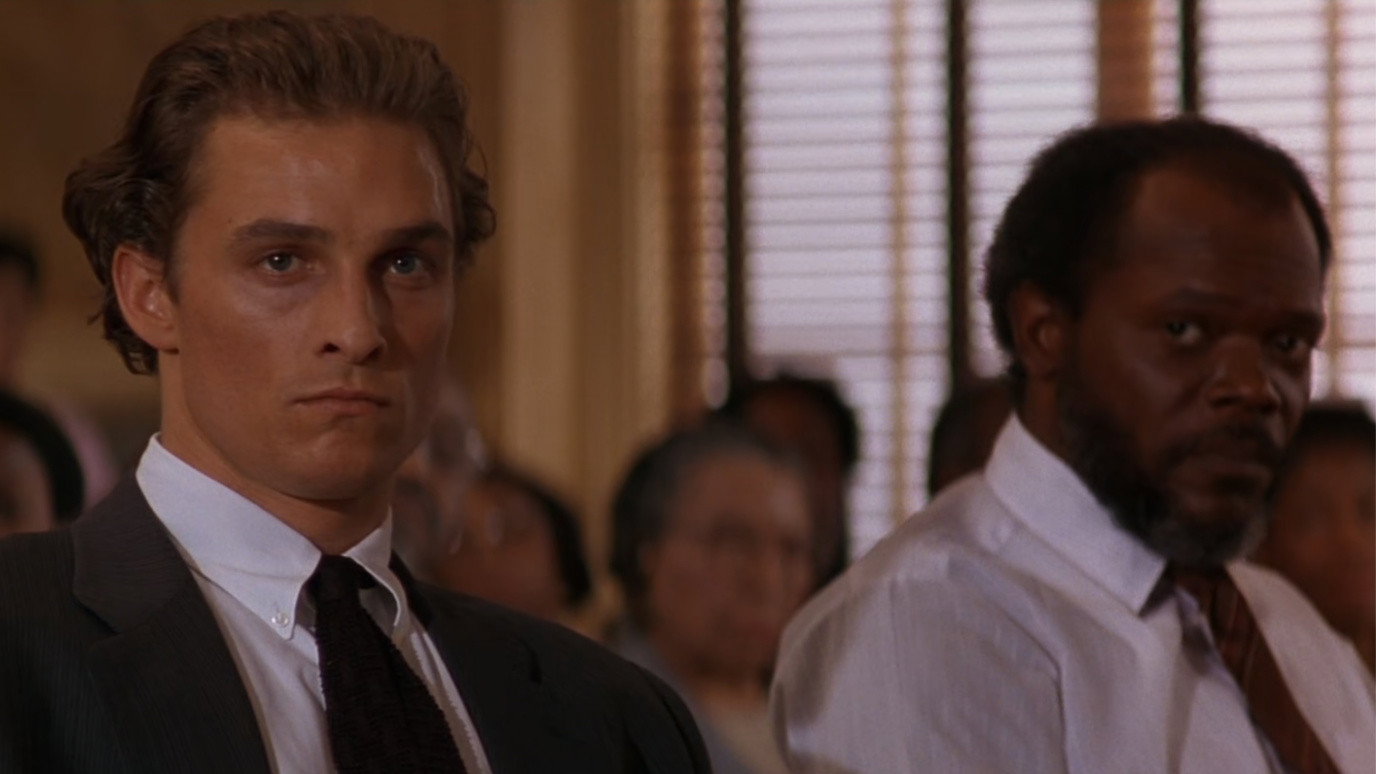
Jake (McConaughey) and Carl Lee (Jackson) in court. The film’s posed centre: white lawyer in the foreground, Black client on the periphery, the actual operator of the story standing slightly behind him.
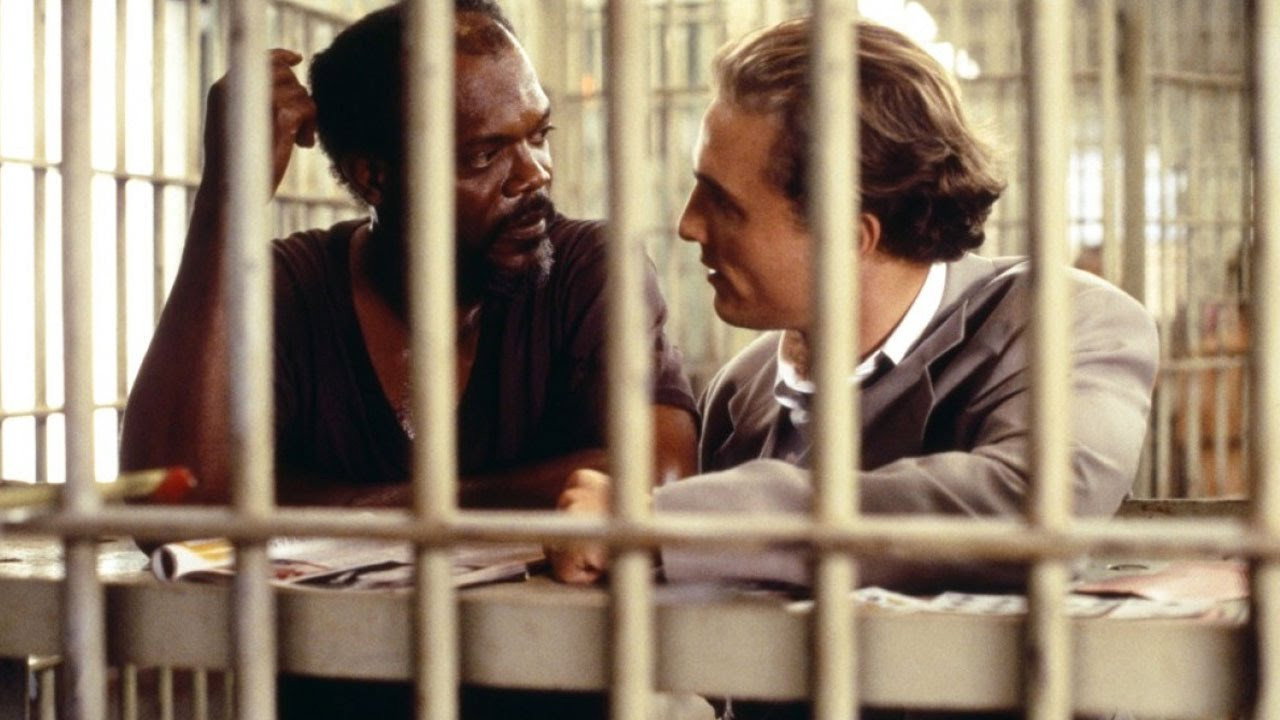
Jake and Carl Lee in the jail. The scene where Carl Lee tells Jake, “you are my secret weapon, because you are one of the bad guys… America is a war and you are on the other side.” The client briefing the lawyer.
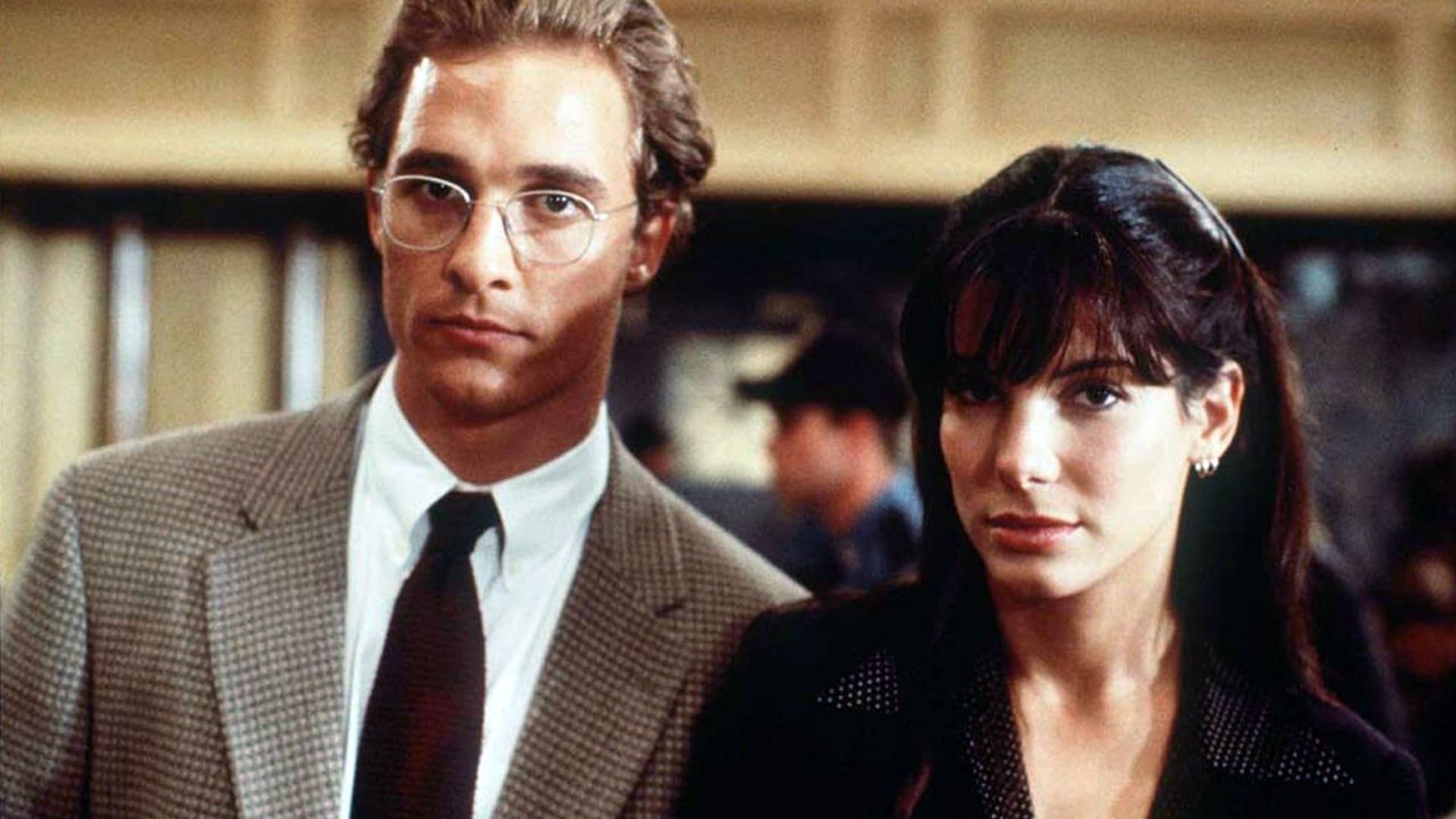
Jake and Ellen Roark (Bullock). The Northern law student who arrives to help, does the heavy intellectual work, and is removed from the room before the verdict.
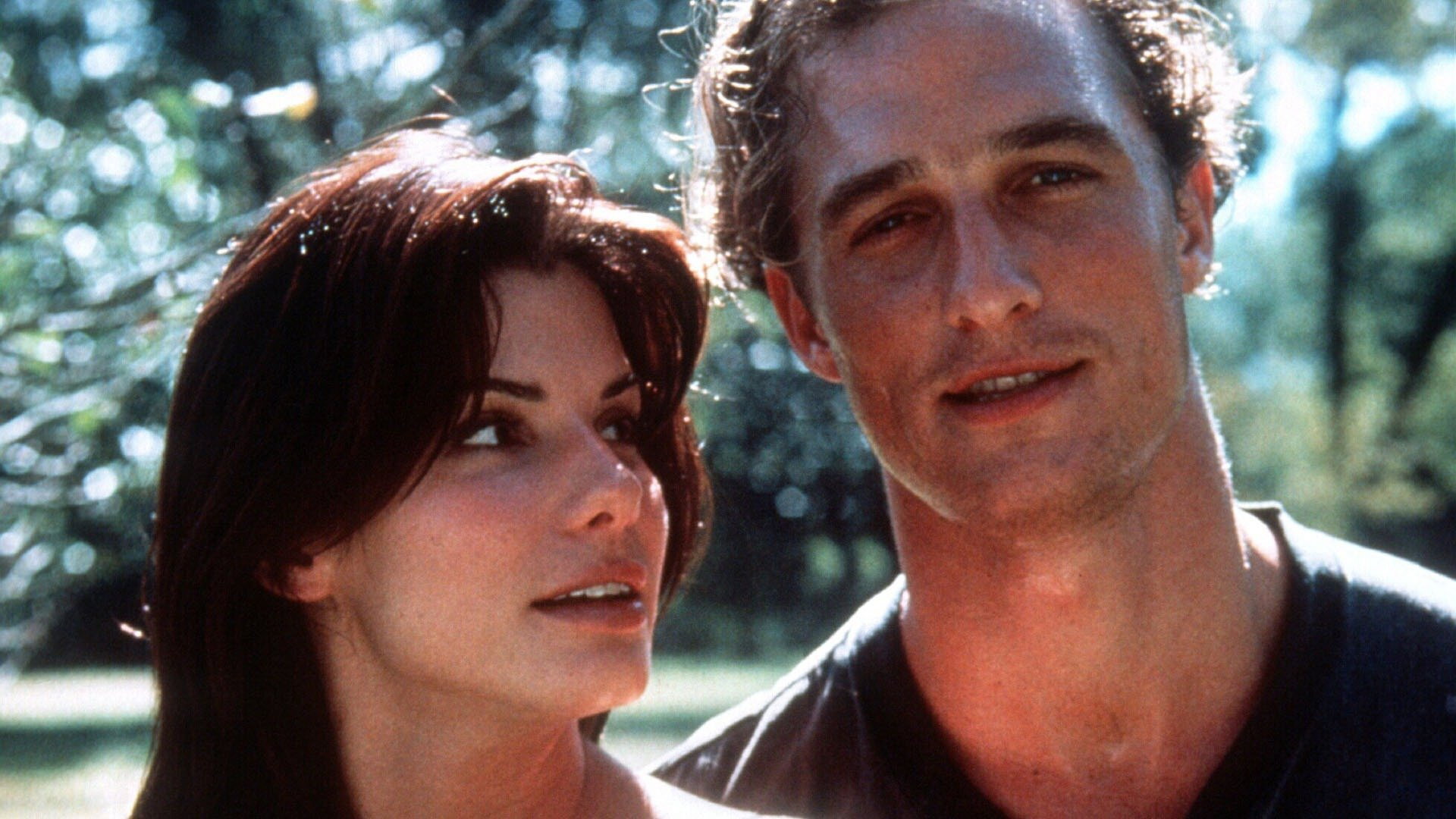
Ellen and Jake outside the office. The refused romance: Ellen as moral and intellectual partner, kept short of becoming the love interest the film needed Jake to refuse.
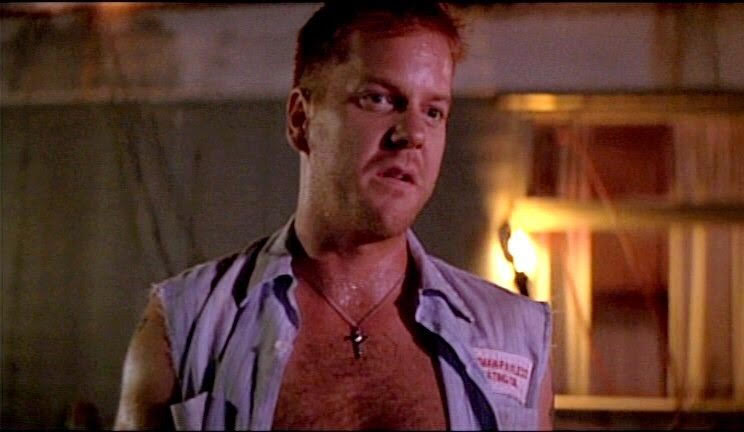
Freddie Lee Cobb (Kiefer Sutherland), the murdered rapist’s brother. The film’s quiet mirror: a grieving man who decides the law is not enough and picks up a weapon — the same logic Carl Lee runs on, dressed in different clothes.
Key Characters
Carl Lee Hailey (Samuel L. Jackson) — A Black mill worker and the father of the raped child. The film presents him as a grieving man who snapped; the film also, more quietly, shows him as the strategist running the entire operation. He chooses Jake specifically because Jake is white. He refuses the NAACP’s celebrity lawyers because he needs an outcome, not a cause. He makes Reverend Agee return the church-collected donations to Jake rather than the NAACP. He briefs Jake on the argument the jury can hear (“you are them”). Samuel L. Jackson plays him quietly so the strategy can run in plain sight.
Jake Brigance (Matthew McConaughey) — A young, idealistic white lawyer who believes the law is something that can be reasoned with. The film treats him as the protagonist on the surface and the instrument underneath. Every step of the case erodes his belief that the system is honourable; by the closing argument he is not appealing to justice, he is weaponising whiteness. His “victory” is not his worldview winning. It is Carl Lee’s worldview winning.
Ellen Roark (Sandra Bullock) — A brilliant law student from a wealthy Boston family who volunteers her time, does the legal research that arms the defence, and offers herself sexually to Jake (he refuses). She is the audience surrogate for the Northern liberal viewer — there to be horrified by Mississippi on our behalf. Her kidnapping and beating by the Klan structurally rhymes with Tonya’s assault: a white woman’s victimisation deployed to make white audiences feel what Carl Lee felt. She is hospitalised before the verdict, removed from the climax so Jake and Carl Lee can finish alone.
Rufus Buckley (Kevin Spacey) — The district attorney; smart, ambitious, hungry for a governorship. The film’s most professionally competent prosecutor. He is not a cartoon racist; he is something more efficient — a man who can prosecute Carl Lee while believing himself to be on the side of law and order.
Freddie Lee Cobb (Kiefer Sutherland) — Billy Ray Cobb’s brother. The film’s hidden mirror: a man whose grief decides the law is not enough and picks up a weapon to deliver his own justice. Operates on the exact same engine as Carl Lee. The film loves one vigilante and fears the other.
Lucien Wilbanks (Donald Sutherland) — Jake’s disbarred mentor; drunk, sharp, willing to tell Jake the truths he doesn’t want to hear. The film’s chorus.
Judge Omar Noose (Patrick McGoohan) — A reluctant, conventional judge who would rather the case go away than be tried fairly.
Themes
- Heart vs. law — The title comes from Ecclesiastes; the film’s whole moral architecture is built on the gap between what our hearts call just and what the law calls legal. Carl Lee is not-guilty in our hearts and guilty in law. The jury does not acquit him on the facts. They nullify the statute. The film celebrates this — and quietly refuses to notice that jury nullification is the exact same mechanism that protected white men who lynched Black men in Mississippi for a century.
- Prejudice flattered, not defeated — The “imagine she’s white” closing argument is treated as a triumph. Read more carefully, it is a confession. Twelve people could only see a Black child as fully human by pretending she was white. Jake did not transcend their prejudice; he hands them a key that fits only one lock and they turn it. The verdict is the right answer for the wrong reason.
- The two vigilantes — Carl Lee and Freddie Lee Cobb’s brother run on the same logic: my grief is bigger than the statute, so I will become the executioner. The film loves one vigilante and fears the other; the difference is who we are asked to root for, not the principle.
- Who actually reads the system — Carl Lee is the only person in the courtroom who sees the system clearly from the start. Jake is the idealist who has to be educated. By the end Jake has been pulled all the way into Carl Lee’s diagnosis of America, and the closing argument is Carl Lee’s reading of the country in Jake’s mouth.
- Marketing, framing, and whose film this actually is — The poster puts Sandra Bullock on top (star power), Jackson at the visual centre, and McConaughey at the bottom. Three hierarchies, three different lies, in one image. The film hides its real protagonist behind a white lawyer because a 1996 mainstream studio film could not openly call a premeditated double-murderer the lead — especially a Black one. The real winner is the man the genre couldn’t openly name as the protagonist.
- The South as system, not setting — Heat, sweat, churches, cross-burnings, sweet tea, courthouse stairs. The setting is not backdrop — it is the operating logic the characters move inside. The heat itself becomes part of the moral atmosphere: everyone is too hot to be patient, and the calm characters (Carl Lee, Jake at his best) read as moral seriousness against that pressure.
Key Insights from the /watch session
These are the readings developed in conversation with Quang on 2026-05-24:
- The “imagine she’s white” verdict is not a triumph. It is a confession. The jury needed a magic trick to do its job. Jake — the supposedly enlightened liberal — already knew that about them, because he is one of them. That is why the trick worked. He was speaking their language. The prejudice did not end. It was flattered into giving the right answer.
- The picnic ending lets the film and the audience off the hook. Not-guilty in our heart, guilty in law. The distinction does not disappear because two families are eating outside together.
- Carl Lee and the Klansman’s brother are structurally identical. Both are vigilantes acting on grief. The film picks which vigilante to love.
- Carl Lee never trusted the law. He used Jake as a tool to survive the act of revenge he had already decided to commit. He did not kill Cobb and Willard and then hope for acquittal. He killed them knowing he would need a white lawyer to translate his vengeance into something twelve white jurors could swallow.
- Jake’s victory is Carl Lee’s worldview winning. By the time he delivers the closing argument, Jake is no longer appealing to a justice system he believes in. He is doing exactly what Carl Lee hired him to do — weaponise his whiteness.
- Carl Lee is the strategist of his own case. He chooses Jake. He refuses the NAACP. He confronts Reverend Agee. He manages Jake’s morale. He plants the closing argument in Jake’s head. Samuel L. Jackson plays him quietly so the operation runs in plain sight.
- The film hides its protagonist behind its lawyer. A 1996 mainstream studio film could not openly call a Black premeditated double-murderer the lead. The genre conventions keep him in the supporting frame; the actual narrative weight is his. The foreground is about a white lawyer; the real winner is a Black man.
Craft Notes
Schumacher’s late style — A glossy commercial filmmaker working in a tradition of social-issue legal drama. The film’s surface is conventional 1990s Hollywood: stars, swelling score, courtroom payoff. The interesting work happens underneath the surface, in what the film shows that it does not quite say.
The “imagine she’s white” closing — Filmed in a single sustained close-up on McConaughey, with cutaways to the jurors’ faces and finally to Tonya’s parents. McConaughey reportedly insisted Schumacher hold the close-up rather than cut around the room. The single-shot choice is what gives the speech its weight — it forces the audience into Jake’s eye-line and therefore into the jury’s position.
Mississippi as character — Shot largely in and around Canton, Mississippi, using the real Madison County Courthouse and former county jail. The film’s geography is not staged. The heat is real. The shot of Carl Lee in the maintenance closet before the courthouse killing is lit in stark shadow, half-hidden — closer to a Western than to a legal drama.
Goldenthal’s score — Elliot Goldenthal’s music leans heavily on gospel and choral lines, especially in scenes involving the Black community and Carl Lee’s family. The score is doing argumentative work: it associates Carl Lee with sacred music while leaving the white characters in conventional thriller scoring. The audience is being asked, at the level of sound, whose side the film is on.
The poster — Worth noting on its own terms. Bullock at top, Jackson at centre, McConaughey at bottom. Three hierarchies in one image: marketing puts the white woman first (star power in 1996), the visual composition puts the Black man at the heart of the design, the genre convention places the white lawyer as the lead. The poster is itself a perfect artifact of what the film does.
Critical & Cultural Context
A Time to Kill premiered in July 1996 and grossed 40 million. It was Matthew McConaughey’s breakthrough — he was largely unknown when cast and his closing-argument performance made him a star overnight. Samuel L. Jackson, coming off Pulp Fiction two years earlier, received an NAACP Image Award for Best Supporting Actor. Sandra Bullock, fresh off Speed and While You Were Sleeping, took top billing on the poster despite a supporting role — a reminder that the marketing hierarchy of the time tracked box-office leverage, not character weight.
The film was John Grisham’s personal favourite adaptation of his work. He had originally refused to sell the novel for years and only agreed when Schumacher and Goldsman committed to the closing argument as written.
Critical reception was mixed. The film was praised for its performances and condemned for its sentimentality and its handling of the racial argument: some critics read the “imagine she’s white” verdict as the moral catharsis the film intends; others read it, as this analysis does, as a confession the film mistakes for a triumph. The disagreement has aged into the film itself — it is now read more often as a study in racial blind spots than as the racial-justice victory it was marketed as.
It also belongs to a specific 1990s sub-genre: the Grisham courtroom drama, of which this is the most morally complicated (The Firm, The Pelican Brief, and The Client are lighter mechanisms; A Time to Kill tries to be a film about something).
Conversation
A /watch session with Quang on 2026-05-24, working from the opening questions about the closing argument, the setting, and the relationship between Jake and Carl Lee. The conversation moved from surface-level appreciation to a reading of Carl Lee as the actual protagonist whose intelligence the film disguises.
Q: The “imagine she’s white” closing argument — triumph or confession?
Quang: When MacConaughey said “Now imagine she’s white.” He turned the story upside down. This picture changed everything. He and the jury had the same look at the beginning. The whole story was around a black man. Because they bring the classification to their mind, they see the situation in a different way. Jake’s saying removed the border between black and white humans. At that moment, people recognised that the killing, if it had been done by a white man, they could receive empathy and forgiveness. Jake accepted his prejudice and used it to save Carl Lee. And in the end, he fixed it by bringing his family to Carl Lee’s home.
Claude: Jake does not defeat prejudice in that courtroom. He uses it. The jury could only see a Black child as fully human by pretending she was white. That is not the prejudice ending — that is the prejudice being flattered into giving the right answer for the wrong reason. The film wants us to cheer, the score swells, but the jury just admitted in front of the whole courtroom that their default setting is to weigh a Black girl’s suffering as less. The verdict is the right answer for the wrong reason. The picnic at the end is the film letting itself off the hook.
Q: Mississippi as character — the setting as system, not backdrop.
Quang: The setting told me that the atmosphere is tense. When everyone is living in high temperatures in the South, it’s hard for them to stay calm. They tend to be angry, and sometimes, they want to deal with everything fast. The calm, control, and feeling ability give us a picture of Jake.
Claude: The heat itself becomes part of the moral atmosphere — everyone is too hot to be patient, and the calm characters read as moral seriousness against that pressure. The South in this film is not backdrop, it is the operating logic the characters move inside.
Q: Did the picnic ending land as healing or as evasion?
Quang: It felt like the film let us off the hook a little too easily. The distinction is still there. Carl Lee is still a killer, although he did that to take revenge. He is not-guilty with our heart, but he is guilty in law.
Claude: That is the whole film in one line. The title comes from Ecclesiastes — a time to kill, and a time to heal — and the film is built on the gap between what our hearts call just and what the law calls legal. The jury did not acquit Carl Lee. They nullified the law. They agreed he did it, they agreed it was premeditated, and they decided not to care. That is jury nullification, the same mechanism that historically protected white men who lynched Black men in Mississippi for a hundred years. Same courthouse. Same procedure. The film celebrates the tool that built the world Carl Lee had to kill his way out of.
Q: Carl Lee vs. the Klansman’s brother — the hidden mirror.
Claude: Carl Lee and Freddie Lee Cobb’s brother are the same man, structurally. Both lost something they loved. Both decide the law won’t deliver. Both pick up a weapon. The Klan rides on the exact logic Carl Lee uses — my grief is bigger than the statute, so I will become the executioner. The film loves one vigilante and fears the other. The difference isn’t the principle. The difference is who we are rooting for.
Quang: You’re right. Your insight changed my feeling about Freddie Lee Cobb’s brother. He thought he’s the bad guy. But he’s taking actions with the same logic as Carl Lee. If the world operated follow the revenge logic of Carl Lee or Klan, the law would be dead. The violent will be escalated.
Claude: If Carl Lee’s logic is right, the rule of law collapses. If it’s wrong, his daughter’s rapists might have walked. The film picks the first horn of the dilemma and just hopes you don’t notice the second. The most radical thing in the movie is hiding in plain sight: Carl Lee is the only character who sees the system clearly from the start. Jake is the idealist; Carl Lee never trusted the law. He used Jake as a tool to survive the act of revenge he had already decided to commit. He killed Cobb and Willard knowing he would need a white lawyer to translate his vengeance into something twelve white jurors could swallow. That is strategy, not faith. Jake’s victory is Carl Lee’s worldview winning. The picnic at the end is not reconciliation — it is Jake quietly accepting that Carl Lee was right about America.
Q: Carl Lee as strategist — the film’s quiet intelligence.
Quang: Yes. Carl Lee is smart. He read and understand the system. He drawed a clever strategy trying to break the system. The way he got money back from the church also let us know how he’s sharp. A black man with intelligent. It’s fascinating.
Claude: You have spotted what the film almost hides from you. Carl Lee is not a grieving father who snapped. He is a strategist running an operation on multiple fronts at once. He chooses Jake specifically because Jake is white. He refuses the NAACP when they try to take over his defence. He confronts Reverend Agee and demands the donations be handed to Jake. He manages Jake’s morale, not the other way around — “you are my secret weapon” is a general briefing an officer. He plants the closing argument in Jake’s head. Jake delivers it. Carl Lee wrote it. The film shows you a smart Black man, but it lets the genre conventions keep him in the supporting-character frame. Samuel L. Jackson plays him quietly so the operation runs in plain sight.
Q: Whose film is this, really?
Quang: The foreground is about a white lawyer. But the real winner is a Black man.
Claude: That is the whole film in one sentence. The film hands the trophy to Jake on screen while quietly slipping it to Carl Lee under the table.
Q: Sandra Bullock — the missing reading.
Quang: In the poster I saw Sarah Bullock at the highest position. You didn’t say a word about her.
Claude: Ellen Roark is a brilliant Northern law student who does the actual legal research that arms Jake’s defence, is set up as both moral conscience and sexual temptation, and is removed from the room before the verdict — the Klan kidnaps and beats her, she ends up in hospital, she is not present for the closing argument. The film clears the white-woman-saviour out of the climax so Jake and Carl Lee finish the work alone. She is the Northern liberal audience surrogate, there to be horrified by Mississippi on our behalf. Her kidnapping structurally rhymes with Tonya’s assault — a white woman’s victimisation used to make white audiences feel what Carl Lee felt. The refused romance marks Jake’s moral seriousness. Her top billing on the poster reflects 1996 star power, not story weight. And the poster itself is a perfect artifact of the film: Bullock on top (marketing), Jackson at the centre (visual composition), McConaughey at the bottom (genre convention). Three hierarchies, three lies, one image.
See Also
- The Interpreter (2005) — another film about a person choosing what to do with the right to kill; both films treat the moral arithmetic of vengeance as the real subject
- Pulp Fiction (1994) — Samuel L. Jackson in the same decade playing the other side of his range; Jules in the diner is also a man choosing not to kill, though for very different reasons
- Evaluating Character — Gioia’s principle that behaviour reveals character better than words: Carl Lee’s actions across the film (choosing Jake, refusing the NAACP, confronting Agee) reveal an intelligence the dialogue underplays