Director: Sydney Pollack
Screenplay: Charles Randolph, Scott Frank, Steven Zaillian (story by Martin Stellman and Brian Ward)
Cinematography: Darius Khondji
Score: James Newton Howard
Studio: Working Title / Mirage / Universal Pictures
Logline
A UN interpreter who fled the fictional African nation of Matobo overhears a whispered assassination plot against the country’s dictator. A grieving Secret Service agent must decide whether to believe her, even as her own past makes her impossible to read. A political thriller built around the question of whether a person who has killed can still choose not to kill.
Plot Summary
Silvia Broome (Nicole Kidman) is a United Nations interpreter who grew up in Matobo, a fictional southern African country torn apart by the genocidal regime of Edmond Zuwanie (Earl Cameron). Zuwanie was once the country’s liberator, the figure who freed it from colonial rule and was called “the Teacher.” Over time he became the tyrant his own movement had defined itself against. He is scheduled to address the UN General Assembly to plead his case against International Criminal Court prosecution.
After a precautionary evacuation of the General Assembly, Silvia returns to the empty interpreters’ booth to retrieve a bag. In the silence she overhears a barely audible exchange in Ku, the rare Matoban language only she and a few others speak. The voices say that the Teacher will never leave the room alive.
She reports the threat. Secret Service agent Tobin Keller (Sean Penn) is assigned to investigate her. He is recently widowed: his wife was killed in a car crash while leaving him, and he carries that loss as a constant low-grade weather pattern. He distrusts Silvia, then begins to suspect she may be more than a witness. Her parents and sister were killed by a landmine; her brother disappeared after joining an opposition faction. She has reasons to want Zuwanie dead.
The investigation widens. Silvia is nearly killed in a bus bombing aimed at an exiled Matoban opposition figure. Surveillance reveals patterns that don’t fit a simple assassination plot. Eventually it becomes clear that Zuwanie himself is staging the “attempt” as a false-flag operation, intended to elicit international sympathy and reframe him as a target rather than a perpetrator on the eve of his ICC defence.
The climax happens not in the Assembly chamber but in a basement room, alone, after the public theatre has collapsed. Silvia has Zuwanie at gunpoint. The audience expects her to shoot. Instead she makes him read aloud from his own old speeches: the words he used decades earlier, when he was the liberator, when his language was still the language of justice. He reads them flatly, without recognition. Then the Secret Service takes him.
He is sent to The Hague. Silvia returns to Africa. The film ends with her quiet and alone, no longer haunted.
Key Characters
Silvia Broome (Nicole Kidman) — A UN interpreter whose entire professional identity is built on the belief that words can do work that weapons cannot. She is not naive about this — she has already killed once, as a child, in self-defence — and her pacifism is a chosen discipline rather than an innocence. The film keeps her ambiguous on purpose: idealist, witness, possible avenger. The audience never fully knows until she chooses not to pull the trigger.

Silvia Broome — vulnerability in the corridors of the UN, the moment her witness role pulls her back into the danger she had built a profession to escape.
Tobin Keller (Sean Penn) — A Secret Service agent doing his job while moving through grief. His wife left him before she died, so he is mourning two losses at once: the marriage, and the chance to repair it. His suspicion of Silvia is professional, but his slow trust of her is personal — they are both people who have been left with the dead.
Edmond Zuwanie (Earl Cameron) — The film’s portrait of how liberators become tyrants. He is mostly off-screen until the basement scene, a presence built through speeches, news footage, and the fear of others. Cameron plays him as a man too far gone to recognise his younger self even when he is forced to read those words aloud.
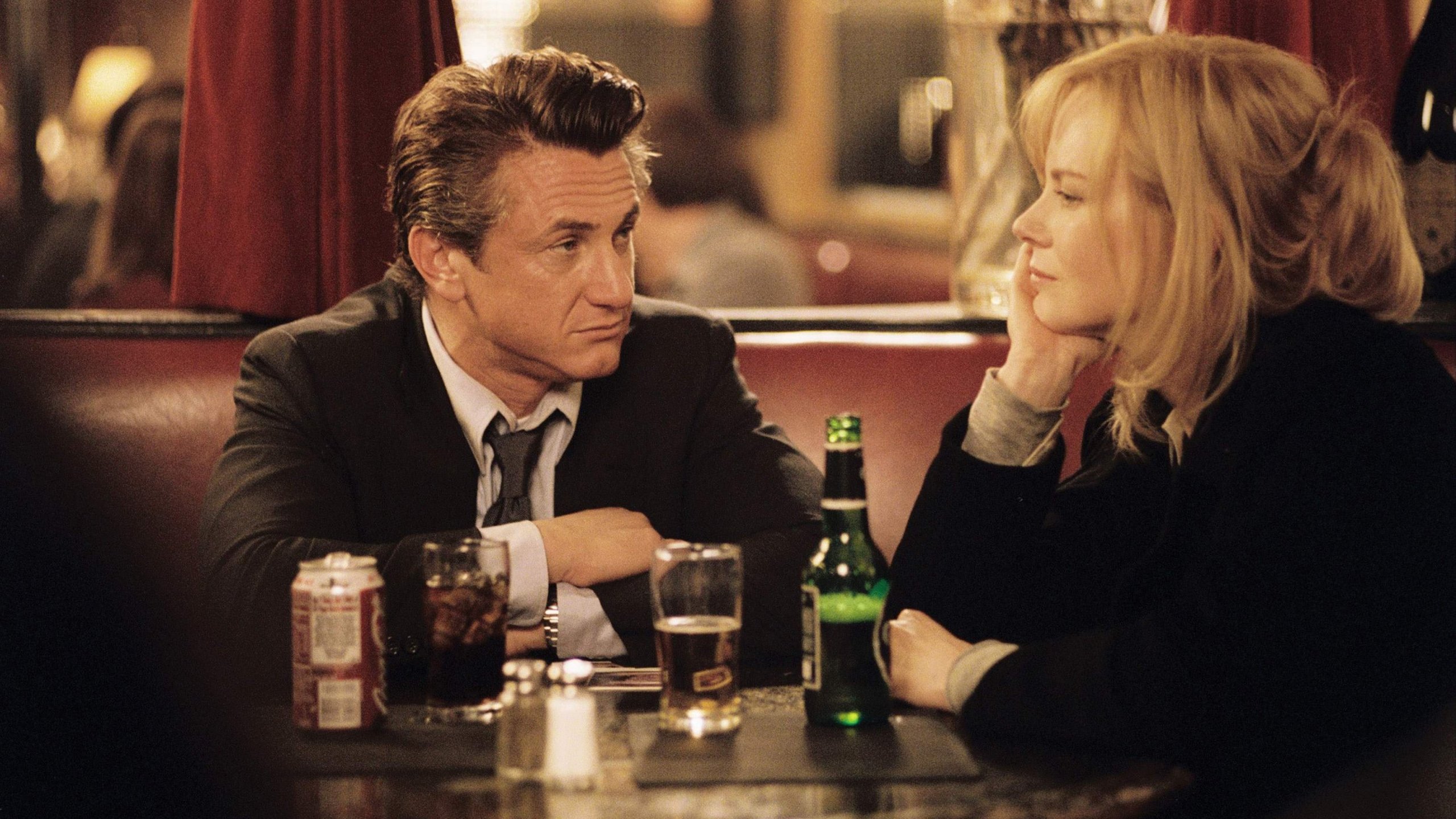
Silvia and Keller at the bar — the heart of the film, where the thriller pauses and becomes a conversation about life, death, vengeance, and forgiveness.
Nils Lud (Jesper Christensen) — Zuwanie’s head of security; the operational architect of the false flag.
Dot Woods (Catherine Keener) — Keller’s partner; sharp and grounded, the voice that keeps him professional when his grief tries to make the case personal.
Kuman-Kuman — An exiled Matoban opposition figure living in New York. His interview with Silvia leads to the bus-bombing sequence.
Themes
- Forgiveness as freedom, not generosity — The Ku people, Silvia tells Keller, believe that if you let your enemy drown, you spend the rest of your life mourning. If you save them, you overcome the hatred. The film treats forgiveness not as a gift to the wrongdoer but as the only available exit for the person who was wronged. By the basement scene, Silvia is not deciding what Zuwanie deserves; she is deciding what she will live with.
- Words as a chosen substitute for weapons — Silvia’s profession is not incidental. The interpreter must transmit meaning faithfully even for people she despises. She has built her life around the belief that this discipline is the slow, durable form of the fight. The film takes that belief seriously rather than ironising it.
- The collapse of liberators — Zuwanie’s arc is the film’s quiet warning: a person can begin with beautiful ideas and end as a génocidaire, and the transformation can happen so gradually that there is no moment of recognition. The forced reading of his own speeches is meant to test whether any recognition is still possible. The film leaves the answer ambiguous.
- Grief as the connective tissue between strangers — Both leads are people whose loved ones were killed or lost. The film cross-cuts their losses gently, building intimacy through shared weather rather than romance. The film resists making this a love story.
- Institutional justice over personal vengeance — Zuwanie is not killed; he is handed to The Hague. The film outsources retribution to international institutions so that Silvia can stay free. Whether this is idealism or evasion is left to the viewer.
Craft Notes
Filmed inside the United Nations — Pollack was the first director ever granted permission to shoot inside the actual UN General Assembly building, including the Assembly Room itself. Kofi Annan negotiated the access personally. The film’s geography is not a set; it is the institution. This is what gives the political-thriller machinery its weight: the building is not symbolic, it is real.
The whisper as inciting incident — The entire plot hinges on a near-silent acoustic event in a language almost no one speaks. The film is interested in small things that travel a long way. The Ku language was constructed for the film by linguist Said el-Gheithy specifically because Pollack wanted Matobo to feel real without singling out any real African country.
Pollack’s late style — This was Pollack’s final film as director (he died in 2008). The pacing is deliberate, almost old-fashioned — closer to Three Days of the Condor (1975) than to the post-Bourne thrillers of its release year. The film prefers conversation to chase, and gives its two leads long scenes where almost nothing visibly happens.
Khondji’s cinematography — Darius Khondji shoots the UN as a place of glass, light, and corridors. Silvia is repeatedly framed alone in vast institutional spaces; the building itself becomes a metaphor for the work of interpretation: hollow architecture filled, briefly, by human voices.
The bus sequence — Pollack constructs one of the film’s two set pieces around a bus in Brooklyn, building dread through composition and silence before the violence arrives. It is one of the most carefully constructed sequences of his late career.
The basement scene — The climax deliberately refuses the assassination-thriller payoff. Silvia does not shoot Zuwanie. She makes him read aloud from his old speeches and then walks away. Pollack chose this restraint over a more conventional ending; whether the audience finds it satisfying is part of the film’s argument.
Critical & Cultural Context
The Interpreter premiered in April 2005 and earned 80 million budget. Critical reception was mixed-to-positive (57% on Rotten Tomatoes, 62 Metacritic): praised for its craft and its two leads, criticised by some for plot implausibilities and a thriller machinery that the film itself seems uninterested in.
The film arrived at a particular political moment — two years into the Iraq War, with international institutions under unusual public scrutiny — and its central question (can the UN actually do anything, or is it theatre?) was read by some critics as either too credulous or too cynical depending on their priors. Time has been kinder to it: the central performances and the basement scene have aged well, and the film now reads less as a thriller about a plot and more as a character study about whether a person who has killed can still choose not to kill.
It is also remembered as the historical record of a unique production access: there will never be another fiction film shot inside the General Assembly chamber.
Conversation
A /watch session with Quang on 2026-05-14, exploring the film through four threads: Silvia’s central contradiction, the interpreter as metaphor, the ending’s refusal of vengeance, and the relationship between the living and the dead.
Q: Silvia’s central contradiction — is she victim, idealist, or quiet avenger?
Quang: She was grow in a war zone, and she learned to adapt with it. As she said, she left the past behind after killing a boy to stop him from killing her. Then she devoted herself to become the UN interpreter, to listen. And to use words to fight the war. It’s slower than weapons, maybe. But she have chose it. I love her conversation with the secret agent. These are about the life and the dead. The revenge and the forgiveness. One moment is still to stick to me is when she explain that “If we let our enemy drown, we spend the rest of our life mourning. But if we choose to forgive, we will overcome the hatred.”
Claude: Silvia is not a pacifist who never had to choose. She has already killed once, as a child, and her later commitment to words is built on top of that knowledge, not as a substitute for it. That is why she can hold the gun on Zuwanie at the end without it feeling out of character. The drowning quote is the philosophy of the Ku people, and the whole film is essentially Pollack asking whether that philosophy can survive a real test.
Q: The interpreter as metaphor — words vs. weapons, others vs. self.
Quang: To save the other people is to save ourselves. I think this proverb is true. It is like when we explain ourself with the others, we achieve two things: understand ourselves better and help people understand. She chose to be an interpreter, her purpose to contribute to the earth’s peace, and in parallel, the peace in her mind.
Claude: Interpretation as a discipline of mutual recognition. The interpreter must transmit even the speech of people she despises, faithfully. That is the slow form of the fight — the form that does not require killing. Silvia’s profession is not incidental, and her inner peace and the peace she serves are the same project working in two directions.
Q: The basement ending — Zuwanie reads his own old speeches and is taken away. Forgiveness, or refusal to kill?
Quang: The ending has a message. The message is that people can be born and grow with a beautiful mind, good actions, but over time, they can become evil, harm others’ lives, even kill people, and become a totally cold-blooded person. But in a moment of remembering, when they pause to think about reality, they can change. Silvia didn’t kill Zuwanie; she chose forgiveness, and along with that, Zuwanie seems to have a recognition moment.
Claude: A second reading is available, and worth holding alongside the first. Pollack is showing Silvia’s redemption, not Zuwanie’s. Zuwanie reads his old speeches flatly, like a man reciting a phone book. Whether anything cracks in him is left deliberately unclear. The forgiveness was for her — the only available exit from becoming the boy she killed.
Quang: It should be that she refused to kill him. She got nothing and became a killer if she pulled the shoot, but she didn’t do it. She’s free now.
Claude: “She’s freedom now” — that is the word the film does not quite say out loud and lets the viewer find. She did not forgive Zuwanie for his benefit. She refused to become him. Those are not the same act, and the distinction is the whole arc.
Q: What do we owe the dead?
Claude: Her parents were killed by a landmine almost certainly laid in Zuwanie’s wars. Her brother disappeared into the rebels. If there is a moment in any life where killing would be justified, this is it. And she still says no. Did she owe her family that bullet? Do the dead forgive her for forgiving him?
Quang: I think dead is over, it’s the end of the story. We don’t need to care about the feeling of death; we need to care about our feelings. How should we continue to live? The reason for living? And keep the love in our hearts, for our sake.
Claude: That is Silvia’s arc, said plainer than the film says it. The dead are gone. What remains is the love, and the love belongs to the living. Vengeance pretends to be loyalty to the dead but is actually a way of keeping them imprisoned in our story. The film’s final image agrees: Silvia goes home to Africa, alone but not haunted. She kept the love. She left the rage.
See Also
- Pulp Fiction (1994) — another film where a character at gunpoint chooses not to kill (Jules in the diner); both films treat the refusal as the redemptive act, not the punishment