Ted Gioia’s argument, written in response to the collapse in teen leisure reading: the crisis is not about pedagogy or test scores — it’s about whether children ever develop a genuine love for books in the first place. Without that emotional foundation, all the teaching in the world falls short.
His evidence is his own childhood, reconstructed as a case study in what actually works.
The Reading Crisis
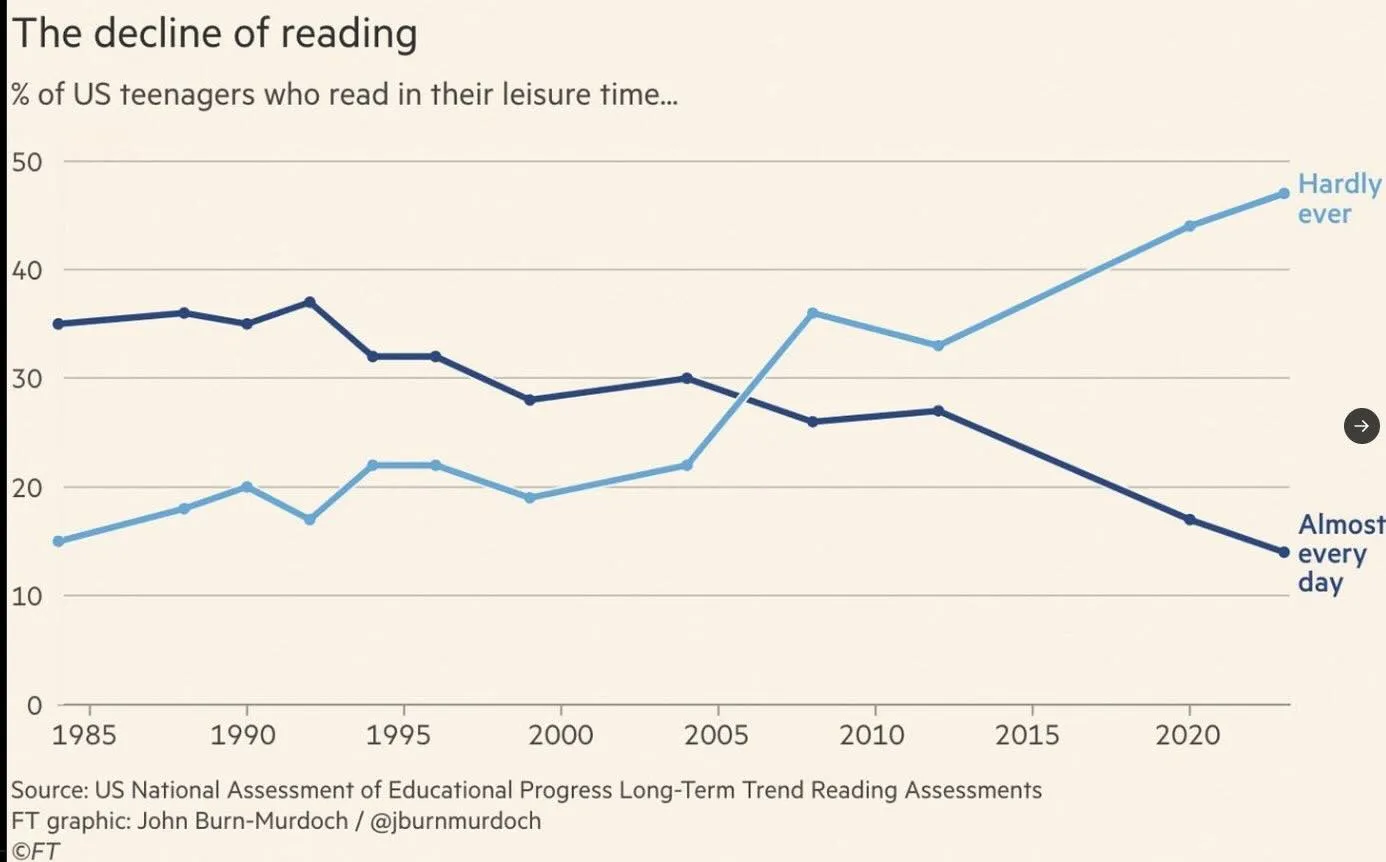
Teen leisure reading has not merely declined — it has collapsed. Source: Financial Times.
Reading during leisure time among American teenagers has fallen sharply across decades. Teachers are increasingly reluctant to assign full books in high school or even college because students won’t — or can’t — read them. Only 2% of Americans with children under nine spend time reading with those children, even though 21% have them.
The diagnosis: most children never get the gateway experience that makes reading feel like pleasure rather than obligation.
The Gateway Experience
Gioia traces his own love of reading to a single, pre-literacy source: a babysitter named Mrs. Gardener who read to him from a two-foot stack of story books, one after the other, for hours at a time.
“I was totally in the flow state. It felt like there was an endless supply of these stories.”
He loved books before he could read a word. When he finally learned to read, the motivation was already in place — he wanted to unlock stories for himself.
This is the key insight: the love of reading must precede the ability to read. Children who learn to decode words without first loving stories approach reading as a mechanical task, not a pleasure.
Gioia replicated this for his own children, reading aloud every night from picture books through to 4,000-page series (all seven Harry Potter books, all the Narnia books, all the Lemony Snicket books). The ritual wasn’t a burden. It was the highlight of the day for everyone.
The Five Conditions
Gioia’s closing synthesis: five things made the difference for him, and all five are still available today.
1. Early exposure to the joy of storytelling
Before pedagogy, before curriculum — a child needs to feel the pleasure of narrative. This happens through being read to, not through being taught. The emotional relationship with stories is the root of everything.
2. Learning to read for fun
After learning to decode, the next critical phase is discovering that you can enjoy this yourself. Gioia’s solo library trips gave him this — unsupervised, unlimited access to books he chose himself.
The freedom of choice is not incidental. Children who are only given “improving” books often don’t develop readers’ enthusiasm. Genre fiction, mysteries, spy novels, science fiction — the “trashy” books from the used bookstore were part of Gioia’s formation, not a detour from it.
3. Role models who read for pleasure
Gioia’s parents hadn’t gone to college, but both read for leisure. His father worked through Will and Ariel Durant’s eleven-volume Story of Civilization out of personal pride in Italian heritage. His mother had poetry memorized.
Neither read to build a career. The message received: reading is something adults do because they love it.
The uncle who died before Gioia was born left a library of books in multiple languages — a working-class intellectual whose ghost suggested that serious reading was possible for people like them.
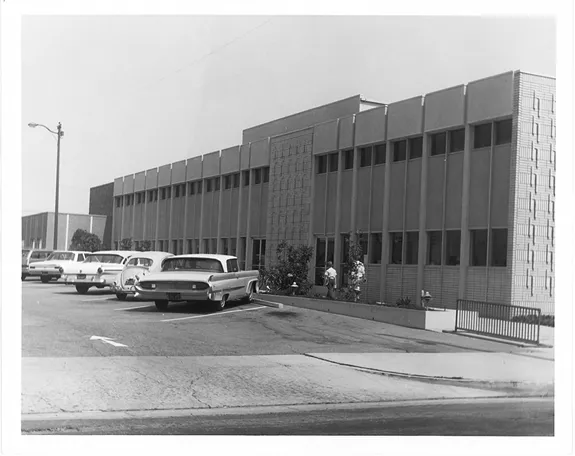
The Hawthorne Public Library as Gioia knew it — a short walk from a South Central LA neighborhood.
4. Easy access to books
The public library was close, unrestricted, and large. Scholastic book catalogs arrived at school, offering five books for two dollars. A used bookstore opened a hundred yards from the library.
None of these required money. The most important was the library: free, nearby, vast, and run by someone who never censored his choices.
5. Gradual confidence that hard books are worth it
At thirteen, a preparatory reading list for high school introduced Gioia to Hemingway, Baldwin, Harper Lee, Steinbeck — adult literary fiction, not the genre books of the previous years. He read it seriously, by choice.
Then Homer, Plato, Shakespeare. He discovered that challenging books were not punishing but exciting — they expanded his thinking in ways that easy books couldn’t.
This transition from pleasure reading to purposeful reading was gradual, not imposed. The foundation of joy had to be laid first.
What This Means for the Reading Crisis
The collapse in teen reading is not primarily a teaching problem. Most educational interventions attack the skill side (comprehension, vocabulary, test scores) without addressing the emotional prerequisite (love, habit, identity).
Gioia’s implicit prescription:
- Read aloud to children, starting before they can read — not to improve their skills but to give them the experience of stories as pleasure
- Give children free, unrestricted access to books they choose themselves — including genre fiction, “unimproving” material, things adults wouldn’t pick
- Be a visible reader for pleasure — children don’t need lectures about the importance of reading; they need adults who clearly love it
- Protect the transition: once pleasure reading is established, introduce harder books gradually; the enjoyment built up in phase one carries children through the difficulty of phase two
And above all: put away the digital devices. Not because screens are evil, but because stories compete poorly for attention against infinite stimulation. The gateway experience Gioia had with Mrs. Gardener required sustained, uninterrupted immersion — the conditions that are hardest to recreate today.
The Prerequisite Framework
This article describes the foundation beneath Gioia’s adult reading methodology and reading for wisdom. Those pages describe the practice of a mature reader. This page describes the conditions that made that practice possible:
Joy of storytelling (pre-literacy)
    ↓
Fun of reading independently (early literacy)
    ↓
Role models + easy access (elementary years)
    ↓
Confidence with hard books (early adolescence)
    ↓
[[Reading for Wisdom]] — the adult practice
    ↓
[[Ted Gioia's Reading Methodology]] — the expert system
The adult system only makes sense if the foundation has been built. Prescribing Gioia’s methodology to someone who never loved reading is like prescribing a training plan to someone who hates running.
Connections
- Ted Gioia’s Reading Methodology — the adult practice this foundation makes possible
- Reading for Wisdom — the disposition this childhood builds toward; the upstream cause
- Self-Directed Education — the free-choice, non-institutional dimension of Gioia’s childhood reading is proto-self-directed-education
- Fast Content vs Slow Content — the reading crisis is partly a symptom of infinite fast content winning the attention war; Gioia’s prescription is to recreate conditions that make slow content feel valuable
- Collapse of the Knowledge System — the reading collapse is one more warning sign; a society that stops reading is a society losing the ability to maintain its knowledge infrastructure