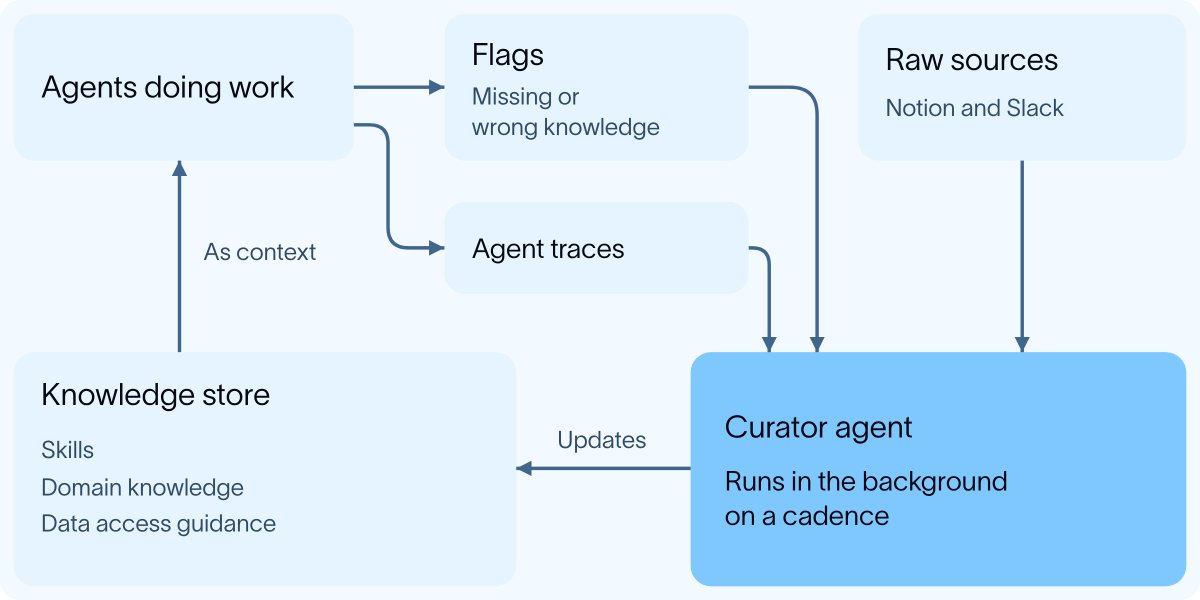
A system that turns the scattered, mostly unwritten way a company works into maintained knowledge that agents can use, and keeps that knowledge fresh by letting the work itself reveal what is missing. From Harrison Chase (LangChain), How to build a knowledge factory. His claim: for AI to work in a company, the missing piece is not better models or even more context, it is better knowledge. LangChain says its internal GTM and content agents, and its LangSmith Engine, each run a learning loop of this shape.
Context versus knowledge
- Context is what the agent has available during a task.
- Knowledge is the reusable understanding kept so the task is done correctly: what a metric means, which source to trust, how a particular situation is handled. Often unwritten, living in your best employees’ heads.
Knowledge becomes context at run time, but it should not be the only context. Fast-changing data should be supplied directly.
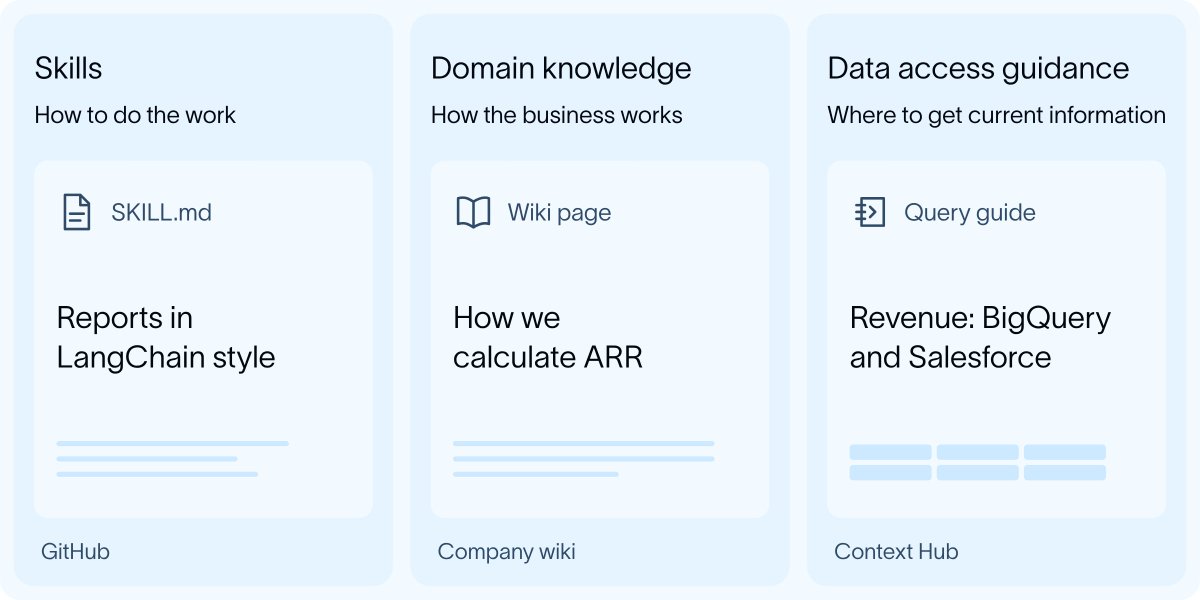
Three kinds of knowledge to maintain
| Kind | What it is | Example | Where it can live |
|---|---|---|---|
| Skills | How to do the work the company’s way; procedures, scripts, instructions | Reports in house style | Skill files in GitHub |
| Domain knowledge | How the business works; slow-changing definitions, policies, facts | How ARR is calculated | A company wiki |
| Data access guidance | Where current information lives and how to query it | Revenue lives in BigQuery and Salesforce | A context hub of query guides |
The third row is the notable choice: do not keep a second copy of data whose source of truth is already complete and current. Keep instructions on what lives where and how to query it.
The three parts of the factory
- A way for agents to flag missing or wrong knowledge. A tool that reports “I could not find this” or “this is wrong”, optionally with the suggested correction. Working agents are the best detectors of gaps.
- A curator agent. Runs in the background on a schedule and does the maintaining. It reads raw sources (wiki, chat), the agents’ traces, and the flags, then updates the knowledge. Keeping humans on this job is too much work, and letting the working agents edit knowledge themselves “will cause it to become unruly and full of contradictions”, because they are focused on their own task and lack the wider picture. So: agents flag, a separate agent fixes.
- Storage. “In some ways the least important thing.” Skill files in GitHub, a Notion page, a knowledge-format file in a context hub, or a graph database all work; the curator should handle any of them. Skills have become the standard for procedural memory, but no standard has emerged for semantic memory, so he advises not being prescriptive.
The worked example
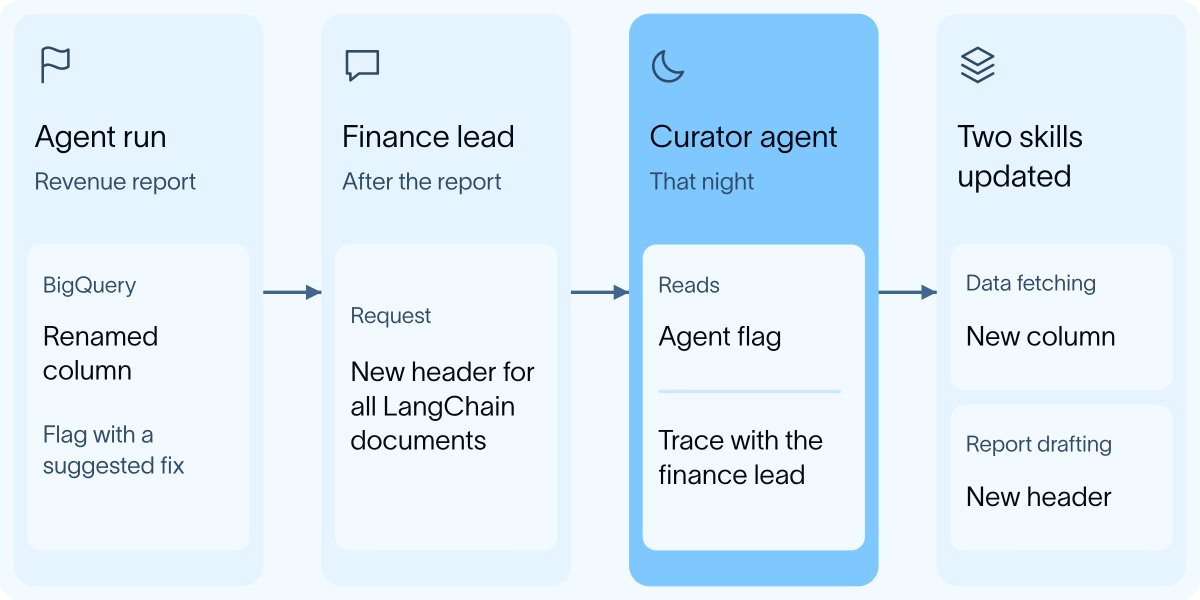
An agent prepares a revenue report. It notices a BigQuery column was renamed, finds the right one itself, and flags the change with a suggested fix. Afterwards the finance lead, working live with the agent, asks for a new header on all company documents. That night the curator reads the flag and the trace of that exchange, and updates two skills: data fetching (new column) and report drafting (new header). Nobody wrote a ticket.
His advice: do not document everything before starting. Start with one recurring workflow, see where agents struggle, and close that loop.
How it relates to the vault
- Third use of “factory”. Software Factory (David Zhang) is about inspecting intent instead of code. Context Systems and Agent Factories (Notion) is shared, monitored agents doing a task. This is the system that keeps their knowledge current. Chase frames it as the next step after software factories. The two newer meanings fit together: Notion’s factories do the work, a knowledge factory feeds them. Notion’s “curing context rot” is a short version of the curator idea.
- Same loop as the ratchet, automated. The Ratchet - Every Mistake Becomes a Rule and Skillify - Meta-Skill Pattern turn mistakes into permanent rules, but a human triggers it. Here the trigger is a flag or a trace and the writer is an agent. Tan’s critique that a tracing platform without a discipline for where lessons live is “a gym membership without a workout plan” (in the Skillify page, aimed at LangChain) is the gap this article addresses, though it does not mention that critique and I am not claiming it is a reply.
- Curator versus self-writing. Self-Improving Agent Memory with Hermes and MUSE lets the agent maintain its own memory with governance, and Personal Agent Operating Rules has the agent extract learnings at day end. Chase argues for a separate curator. That is a real design disagreement, and his page gives no experiment to settle it.
- Data stays where it is. Notion’s guide says to sync everything into one system. Chase says keep a pointer, not a copy. Both want one reliable place for agents to go; they disagree on whether the data moves. For a company with a mature warehouse, Chase’s position avoids duplication and sync lag.
- Basis: Context Engineering, Agent Memory, Agentic Data Analytics (data guidance is the same problem).
- This vault is a manual knowledge factory. Ingest writes knowledge, Lint finds stale claims and contradictions,
decayandreview_bymark what rots, the log records changes. The curator is you plus an assistant, on request, with a human approving the writes.
Tensions and caveats
A vendor article with no results
LangChain sells the tooling it names (traces, scheduled managed agents, a context hub) and ends with “reach out”. No numbers, no failure cases, and the examples are internal. Treat it as a pattern, not a proven result.
- Who approves the curator’s edits? Nothing here mentions review, versioning or rollback. One finance lead’s request for a new header becomes a permanent rule for everyone. Whether a single instruction is a one-off preference or company policy is a judgment the curator must guess. Self-Improving Agent Memory with Hermes and MUSE lists exactly this as open: should one user correction bypass repeated-evidence requirements? A safer pattern is the curator proposing changes as a reviewable diff.
- Curator access is broad. It reads raw sources such as chat and wiki, plus the traces of everything agents do. That is a large pool of sensitive data in one agent’s hands, with write power over what every other agent believes. See Agent Security and Threat Model; a poisoned document or trace could be turned into a skill.
- No quality loop on the curator itself. There is no mention of evals for whether its updates help, so contradictions could build up in the store while each edit looks reasonable. Compare the prompt-versions-plus-evals loop in Context Systems and Agent Factories and Eval-Driven Agent Development.
- Flag quality. The loop depends on agents noticing what they did not know. An agent confident about something outdated (the stale-cache failure in Personal Agent Operating Rules) will not flag it.
- Storage “least important” is overstated. Format drives who can review, diff and revert the edits, which is the control the factory most needs.
- Not tried. The LangChain posts it links were not read and none of its products were run here.