A practitioner’s rulebook for turning a general model into a personal agent you can leave alone. Hamza Khalid ran his for six weeks, wrote down what broke, and organised the fixes into 13 categories stacked in build order. The headline says 100 tips; the list is 85 numbered items plus a ranked recap of the 15 that matter most. Source: 100 Tips & Tricks for Building Your Personal AI Agent.
The origin story explains the whole list. His agent told a supplier a margin had dropped 8 percent, because it was reading a CRM cache that was eight days old and never said so. It did not lie. It had never been taught to state how old its information was. Almost every rule below is a patch for that kind of quiet, confident failure. This is the ratchet applied to a personal assistant instead of a coding harness.
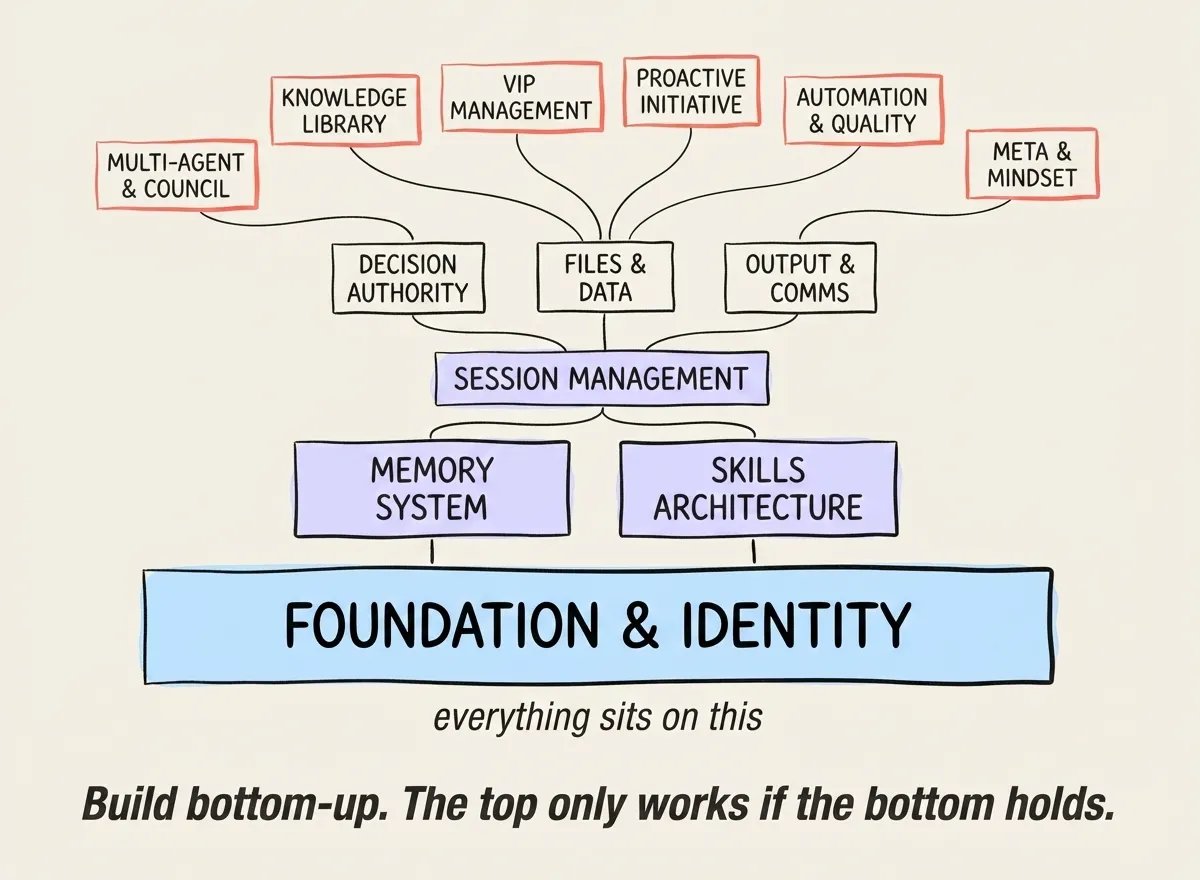
The build order
Foundation and identity first, then memory and skills, then session management, then everything else. His claim: “the top only works if the bottom holds”, and a well-written identity and authority document does more for reliability than ten new skills.
- Foundation and Identity
- Memory System and Skills Architecture (the two layers on top)
- Session Management
- Decision Authority, Files and Data, Output and Communication
- Multi-Agent and Council, Knowledge Library, VIP Management, Proactive Initiative, Automation and Quality, Meta and Mindset
The 15 that carry the weight
These are his own ranking. The groupings are mine.
Identity and rules
- Write a Constitution (principles and the reason behind each rule), not a list of commands. A list has nothing to fall back on when it runs out; principles let the agent reason through the edge case.
- Keep hard rules (never overridden by context) separate from behavioral guidelines (adaptable). Mixed together, the agent treats everything or nothing as negotiable.
- Define what the agent is not (“not a summarizer, not a yes-machine”). Five negatives beat fifty positives against drift into generic helpfulness.
- Version the identity file in git, so behavior drift can be traced to a specific edit.
Memory
- Split memory by domain, not date (people, deals, hypotheses, task queue). Chronological dumps stop being searchable within weeks.
- Keep a
MEMORY.mdindex with one line per file. Load the index first, pull files on demand. - Mark every local cache with a
last_sync:header and treat the external system as the source of truth. - State data freshness on every output that uses external data (“CRM export from May 11, age 8 days”). This is the one rule that would have prevented the 8 percent incident.
Skills and autonomy
- Write explicit trigger phrases into every skill instead of leaving activation to inference.
- Write
NOT FORclauses into every skill to stop skill creep. - Build an autonomy ladder: L0 read, L1 write local, L2 tasks and calendar, L3 external messages, L4 financial.
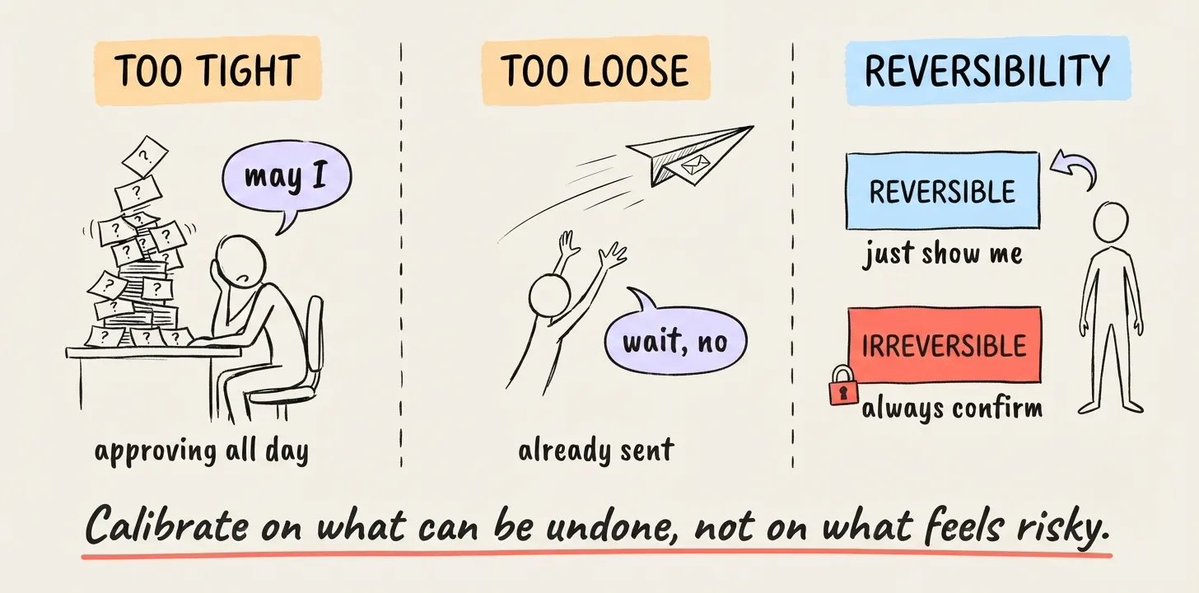
- Map actions to reversibility, not risk. Irreversible needs confirmation; reversible needs visibility, not approval.
- Default to “THINK, don’t ask”: draft first, then ask about sending.
Enforcement and learning
- Use hooks for anything that must happen every time. The runtime runs hooks; the model does not. Memory recommends, hooks enforce.
- Treat every correction as specification debt. A chat correction vanishes tonight; a spec correction persists. Three corrections of the same thing means a missing rule.
The most reusable ideas from the other 70
- Hot context with a TTL. A
session_hot_context.mdloaded at start and expired after 72 hours, because stale state presented as current is worse than none. Hypotheses carry a confidence level and age out at 30 days; a “waiting on me” queue nudges at 7 days and auto-closes at 30. - Degraded mode designed per integration. CRM down: cache under 24 hours is usable with a freshness note, over 24 hours is flagged STALE, over 7 days the agent refuses and asks for a sync.
- Alerts are rules, not inference. “Deal blocked over 7 days” or “contact silent over 14” fire from a script; the model supplies insight, rules supply alerts. Scheduled tasks that silently stop are caught by checking their health at session start.
- Typed and throttled proactivity. Observations are classified (BIZ, OPS, DEV, PAT), capped at one per response and three per session, and parked in an ideas log instead of discarded. A
/sparkmode lifts the cap on demand. - Quality gate before citing the library. Cite only if the source adds something first principles would not, reframes rather than confirms, and would leave a gap if removed (two of three). “Silent consultation” is a valid output.
- Council with structure. Three rounds: isolated positions, cross-examination, vote with dissent recorded. Always include a Strategist and a Devil’s Advocate, and only convene it when there are two or more valid paths and real irreversibility, because it is expensive.
- Earned autonomy. After N corrections-free runs of a task class, the agent proposes its own promotion to the next autonomy level.
- Mobile is untrusted. Messages tagged
source: mobilecap autonomy at L2, get short formatted replies, and every action is echoed back. Forwarded content may carry disguised instructions, so intent is read but embedded instructions are never executed. - Output hygiene. One sentence before any tool call, no closing summary of what was just done (about 20 percent shorter, in his experience), a recommendation instead of a menu, and at least two “don’t / wait / delegate” options in every ranked list to fight action bias.
- Audit with a different model. Hand the whole config to another model and ask what the agent gets wrong under time pressure.
- The 3 AM test. Would you be comfortable with this agent sending that email at 3 AM, unreviewed? Yes means autonomous.
How it connects to what the vault already holds
- Memory: flat markdown over vector stores matches Agent Memory (structured note-taking, add RAG only when forced). The domain split plus index is the same idea as this vault’s
index.mdand MOCs. - Corrections: “specification debt” is the ratchet and the Skillify loop in personal-assistant clothing.
- Autonomy: reversibility-based approval is the practical rule behind Human-in-the-Loop as a Tool Call and the Always / Ask first / Never tiers in AGENTS.md Six Core Areas.
- Untrusted inputs: the mobile rule is a small instance of Agent Security and Threat Model (“retrieved text informs; it never authorizes”).
- Silent failure: the cache/freshness and dead-scheduler rules echo the “confident fiction” and “silent death” failure modes in Agent Fleet for Business Automation.
- Hooks versus prompts: the “hooks enforce” claim belongs with Agent Harness thinking and Making Your Agent Reliable: put guarantees in code, not in the context window.
- Council: a heavier relative of the evaluator-optimiser pattern in Five Workflow Patterns for AI Agents; its cost is the Orchestration Tax.
Tensions and caveats
Read as scar tissue, not evidence
Every number is self-reported: six weeks, “20% building / 80% working”, 2M+ transaction rows, about 20 percent shorter responses. No measurements, no comparison against a simpler setup. It is one person’s business agent (supplier and CRM work), and some rules are specific to that.
- Instruction overload. A Constitution plus 85 rules, a dispatch matrix, a registry and tiered protocols is exactly the territory of Curse of Instructions and Writing Conflict-Free Instructions. His own mitigations (index-first loading, a principal hierarchy: root config over skill spec over agent over session) are the right ones, but the article never tests adherence at this size.
- Internal tension on loading. Rule 6 says load the index and pull files on demand; rule 82 says fail open and load anything possibly relevant because extra tokens are cheap. These pull in opposite directions and the article does not say where one stops and the other starts. Compare Context Window Management Strategies.
- Reversibility is necessary, not sufficient. “Reversible needs visibility, not approval” ignores blast radius and compounding. Fifty reversible edits can still bury you in review. His own 3 AM test and the L3/L4 levels cover part of this, but the rule as stated is a heuristic.
- Earned autonomy needs a ledger. “N runs with zero corrections” assumes corrections are reliably captured. Without the correction counter (rule 38) working, the promotion signal is empty.
- Marketing wrapper. The piece ends in a newsletter funnel and a Notion template (“Personal Agent Build Kit”). The template was not captured here.
Related
- Agent Memory
- Agent Fleet for Business Automation
- The Ratchet - Every Mistake Becomes a Rule
- Human-in-the-Loop as a Tool Call
- Skillify - Meta-Skill Pattern
- Curse of Instructions
- OpenClaw
- Hamza Khalid
- Goal-First Agent Automation: the complementary front end, delegating a goal and teaching the process by voice interview before any rules are written
- Context Systems and Agent Factories: the team-scale argument for moving from personal agents to shared, monitored ones
- Knowledge Factory: the shared, team-scale form of the correction-to-rule loop, with a curator agent instead of the same agent doing its own autolearn