Ted Gioia’s philosophy of money, distilled from a lifetime of living as a creative in a consumerist world. The thesis: money’s value is entirely determined by the purpose you use it for. Consumerism cannot replace meaning. Independence — not wealth — is the goal.
This is not anti-money thinking. It is a specific, disciplined use of money: to buy freedom.
The Pro Athlete Who Had Everything
Gioia opens with a story. A pro athlete retires at 32 with $100 million. The interviewer assumes happiness. The athlete says: “Miserable.”
Sports had given him purpose, discipline, camaraderie, and a daily regimen since age 6. When it ended, he had no framework to replace it. He drove 30,000 aimless miles in a single year just to fill the hours. “Do I go to the f***ing mall? How many malls can we go to?”
The watches at the mall are “the most ironic purchase of them all — they remind him of all the hours that now pass by without meaning.”
The lesson: purpose precedes money. Without a sense of who you are — a vocation, a calling, a community — money is an empty unit. More of it cannot help you.
Creatives Have a Structural Advantage
This is a counterintuitive claim in a world that pities struggling artists. But Gioia’s argument is precise: creative people already operate with a higher purpose. They have a reason to get up. They have a daily practice, a craft they are working to develop, and — ideally — a community of collaborators.
The enemy is not poverty. The enemy is purposelessness. And purposelessness is common across all income brackets.
“You are already far ahead of the game, if you have found your vocation, or calling, or some other meaningful life’s work.”
Take Money Seriously — But Never Let It Rule You
Artists are typically taught to ignore money. Their teachers never address it. The standard advice — “do what you love and the money will follow” — Gioia calls demonstrably false. He has seen too many GoFundMe campaigns from talented people who did exactly that.
His alternative path:
- Develop a second marketable skill alongside your creative work, completely separate from your vocation. The model is Philip Glass, who worked as a plumber, taxi driver, and crane operator until age 42 before going full-time on music.
- Keep your costs genuinely low. Not as an ascetic discipline, but as a strategy: low costs convert modest income into independence.
- Define “enough” before you need to. This is the mental move that frees you.
Gioia practiced this himself. Working-class background, no trust fund, wife in modern dance (a field even less lucrative than jazz writing). In his twenties: 1,000/month total.
“That’s the one thing I possessed that even my wealthiest friends lacked. Enough.”
Independence vs. Wealth
When a Silicon Valley billionaire asked why Gioia was teaching jazz with a Stanford MBA, Gioia said: the purpose of money is independence.
The billionaire was confused. Don’t you need a lot of money to be independent? No. You need enough — and enough is a much smaller target than wealthy people imagine.
Independence buys freedom to create. And freedom to create is worth more than any status purchase.
“Independence will give you freedom to create. And it’s still possible to buy independence on a tight budget. That’s a better deal than any of the consumer goods sold at the mall.”
The 6 Rules
-
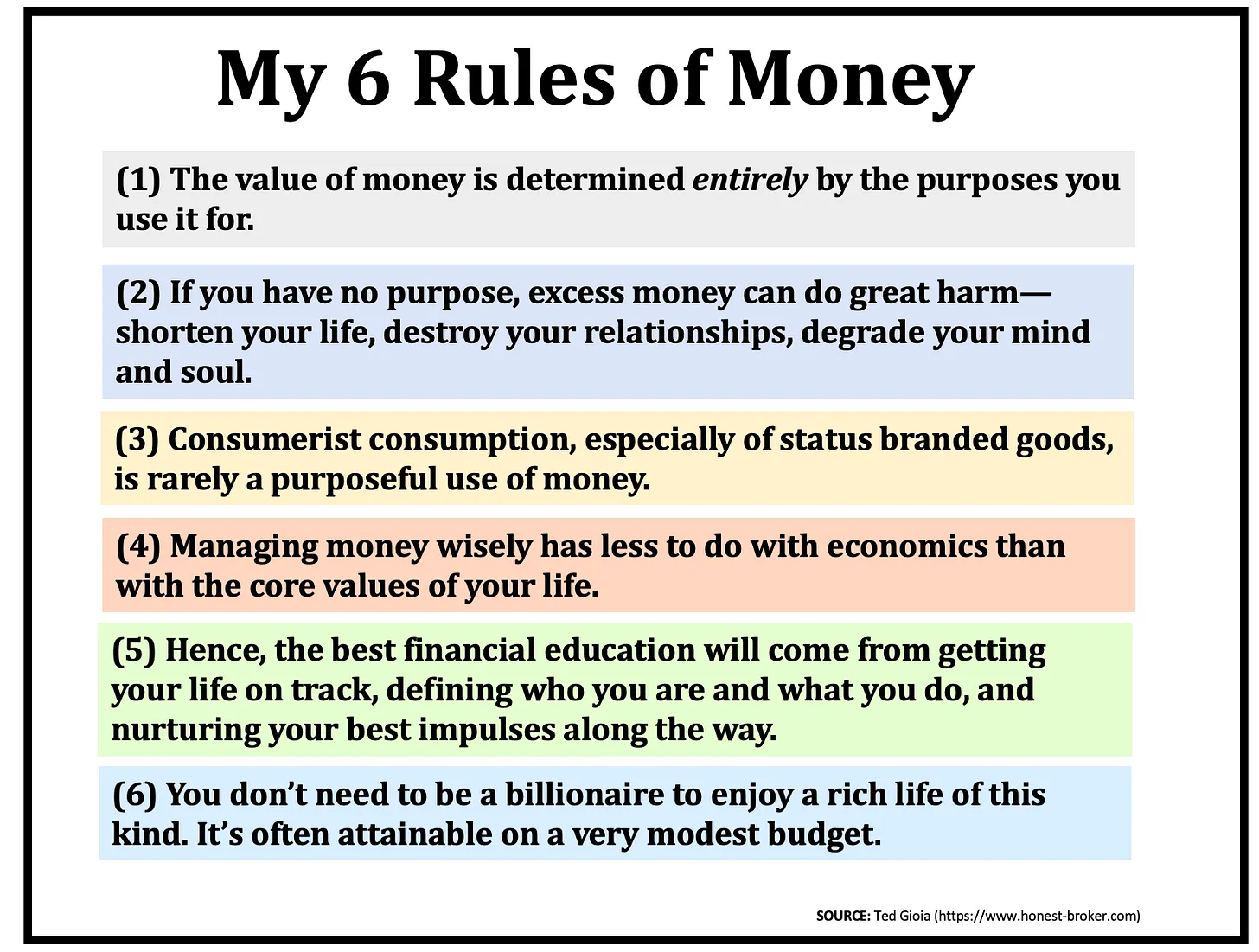
The value of money is determined entirely by the purposes you use it for. Economists treat one dollar as always equal to one dollar — this is a dangerous mistake.
-
If you have no purpose, excess money can do great harm — shorten your life, destroy relationships, degrade your mind and soul.
-
Consumerist consumption, especially of status goods, is rarely a purposeful use of money. It’s usually compensation for something lacking in life.
-
Managing money wisely has less to do with economics than with the core values of your life. You can’t maximize wealth unless you understand what wealth actually is.
-
Your best financial education comes from getting your life on track, defining who you are, and nurturing your best impulses. Not from economics textbooks.
-
You don’t need to be a billionaire to enjoy a rich life. It’s often attainable on a very modest budget. This is how you get rich on the cheap.
Connections to the Rest of the Wiki
Resonates deeply with The Meaning Economy: Dan Koe argues that meaning is the scarcest commodity in the 21st century — exactly what Gioia is pointing to. The athlete’s $100 million couldn’t purchase what he actually needed. The meaning economy is not a metaphor; it is the literal situation of anyone who has solved the money problem and discovered it wasn’t the problem.
Extends Self-Directed Education: Gioia’s financial philosophy is the same structure as his educational philosophy: start with your own inner life, develop deliberately, take the long view. He was doing this with money before he had language for it.
Is the practical flipside of New Romanticism: The cultural revolt against algorithmic technocracy and the personal revolt against consumerism are the same impulse at different scales. Art for art’s sake (1804) and independence for independence’s sake (Gioia’s twenties) are both rejections of the utilitarian calculus.
The Philip Glass model is an applied version of what Gioia himself did — and what the humanities curriculum prepares you for: a life where your inner development and your outer livelihood are distinct tracks, running in parallel, both taken seriously.