Ted Gioia’s thesis that the cultural backlash against algorithmic technocracy will — or already does — resemble the Romanticist revolt against Enlightenment rationalism that swept Europe circa 1800. What began as a flippant remark became a serious research project: year-by-year notes on 1800–1804, looking for the historical blueprint for our own moment.
This is also the direct answer to the question posed at the end of Collapse of the Knowledge System: what replaces the dying knowledge hierarchy?
The 1800 Parallel
| Circa 1800 | Circa now |
|---|---|
| Rationalist and algorithmic models dominating every sphere of life | Algorithmic and mechanistic thinking dominating every sphere |
| ”Dark Satanic mills” (Blake); Luddites burning factories | Smartphone bans in schools; tech backlash |
| Dysfunctional behaviors alongside technological progress (Werther, Gothic novels) | Rising youth suicide, self-harm, mass disconnection |
| The creative class attacked rationalism turned violent and intrusive | Artists, writers, musicians pushing back against the attention economy |
| Newton became a term of abuse | ”Learn to code” became a punchline |
| Artists celebrated human feeling as more trustworthy than cold calculation | The [[The Meaning Economy |
Gioia’s summary: “the more I looked at what happened circa 1800, the more it reminded me of our current malaise.”
The Central Claim: Music as Early Indicator
Gioia’s signature thesis throughout his career — and the lens through which he analyzes the historical evidence — is that music precedes social change. Beethoven’s new emotional vocabulary arrived before anyone had language for what was happening culturally. The Romanticist aesthetic shift was audible before it was nameable.
This has a direct implication for now: if a New Romanticism is underway, music will be the first place to see it. What does the New Romanticism music sound like today? Gioia poses this as an open question he has not yet answered.
The Historical Blueprint (1800–1804)
Wordsworth’s 1800 manifesto — The preface to Lyrical Ballads declared that poets should use “language really used by men” — the common people, not the educated elite. A missile aimed at Oxford and Cambridge. Gioia’s reading: this is the populist turn that never resolves, the tension between elite and folk aesthetics that still runs through every culture war.
Schelling’s unconscious (1800) — Published the same year as Wordsworth’s manifesto, Schelling’s System of Transcendental Idealism positioned art as the healer of the divide between objectivity and subjectivity. His concept of the unconscious reframes it: not something to fear, but the source of freedom. “The Enlightenment is officially over.”
Removing the light from the Enlightenment (1801) — Novalis’s Hymns to the Night and the paintings of Caspar David Friedrich mark the shift: from aesthetics of light to aesthetics of dark.
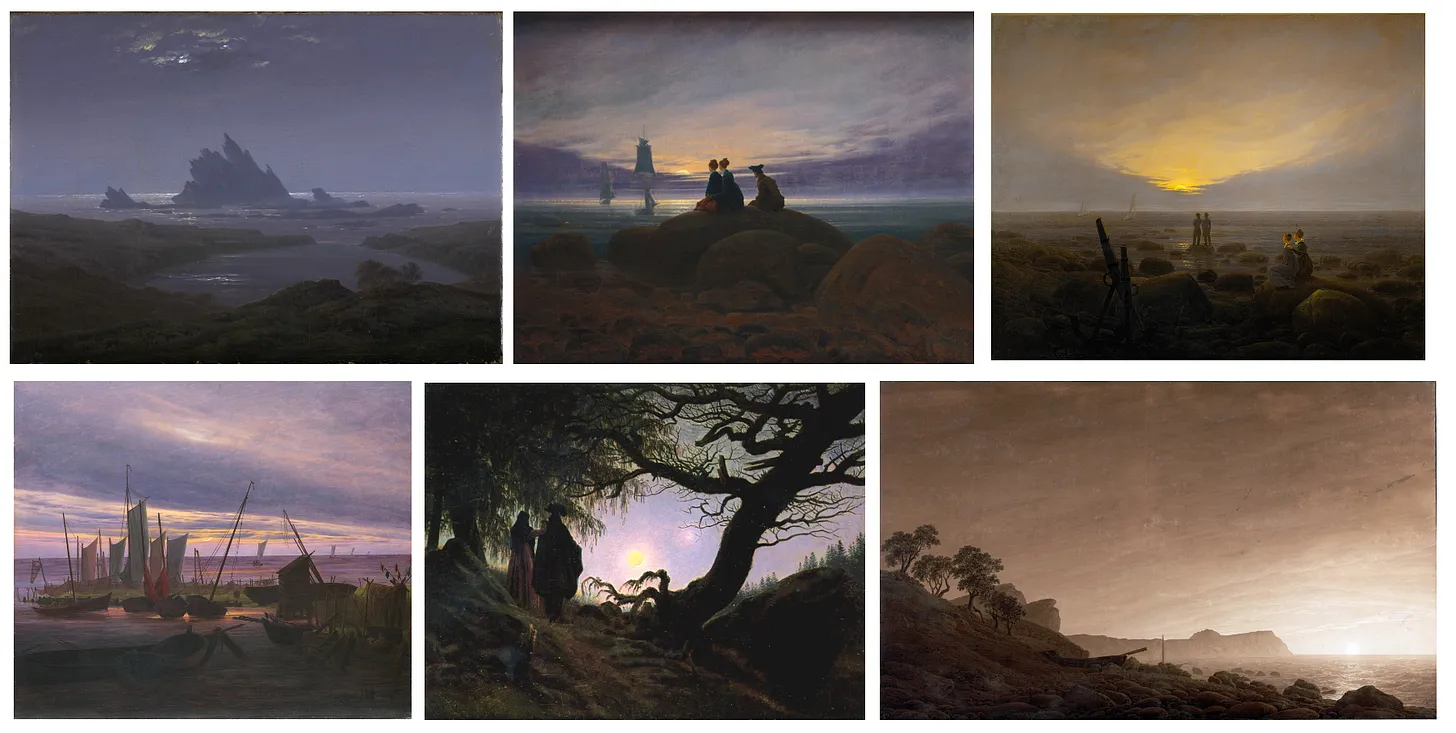
Caspar David Friedrich (1774–1840) — the visual signature of the Romantic shift
Gioia’s hypothesis: “When rationalistic and algorithmic tyranny grows too extreme, art returns to the darkness of the unconscious life — and perhaps of the womb.” He conjectures we are making a similar shift right now.
Beethoven at 30–32 (1800–1802) — The most vivid embodiment of the transition. Over three years, Beethoven invented an entirely new emotional vocabulary for Western music. Crucially: his music advanced more radically after the onset of deafness. Working in isolation, unable to hear the external world, he turned inward with unprecedented force.
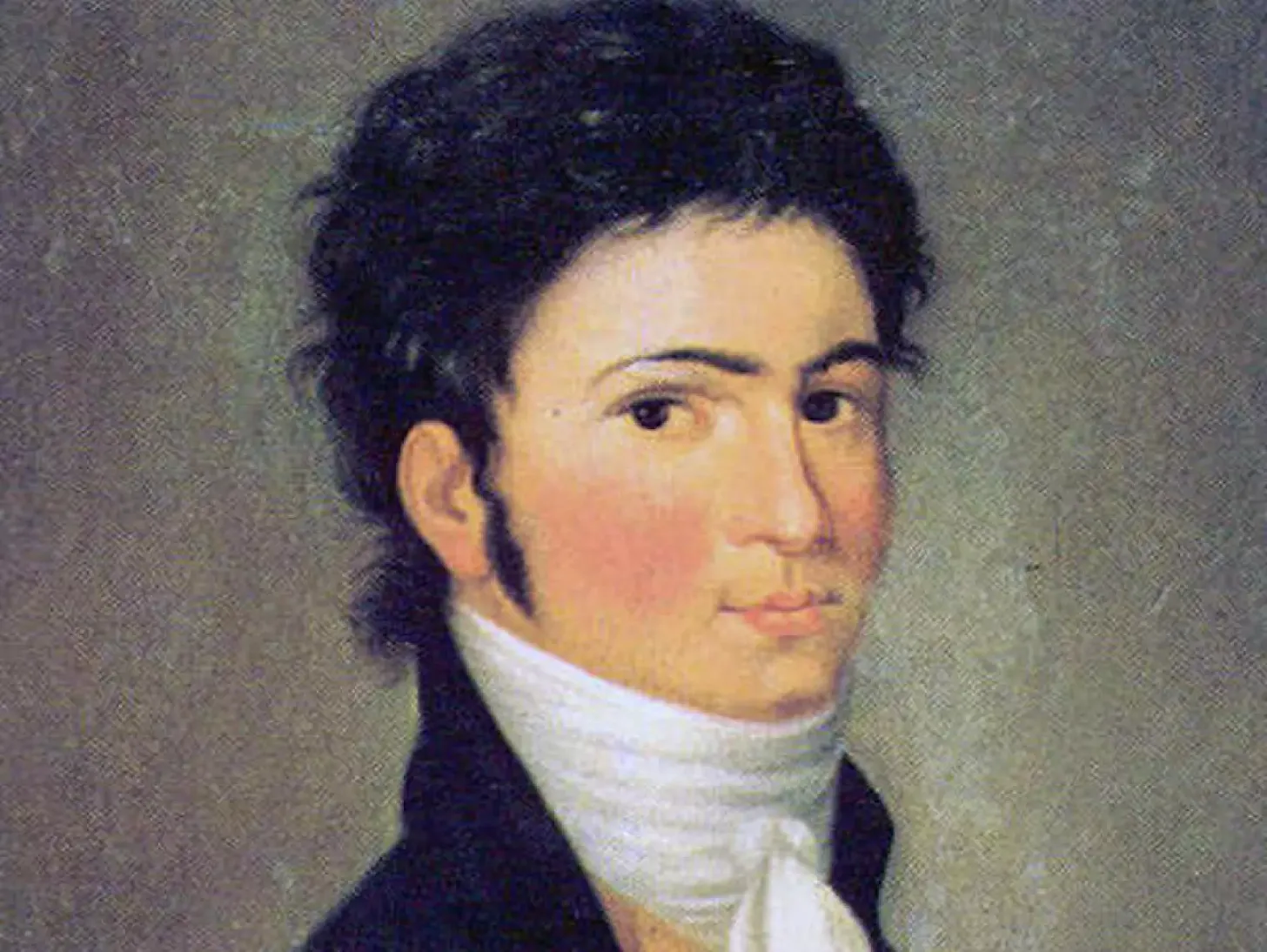
Beethoven at age 30
Haydn, meanwhile, transitions from livery-wearing servant of the Esterhazy family to self-described “priest of this sacred art.” Great composers are no longer servants — they receive more acclaim than scientists or captains of industry. A new cultural hierarchy is forming.
“Art for art’s sake” (1804) — First use of the phrase. Not merely a defense of creative spirit: a rebuttal to scientism and its pretensions as the ultimate ruler of human destiny. Beethoven turns against Napoleon in the same year — the Romanticists who had hoped rationalism would deliver freedom discover it has delivered tyranny instead.
What the New Romanticism Would Look Like Now
Following the historical template:
- A growing revolt against STEM’s cultural dominance
- People discovering that the good life begins with NOT optimizing, NOT learning to code
- Artists and musicians leading the cultural backlash, not politicians or academics
- The unconscious — dreams, emotion, the body, nature — returning as legitimate sources of meaning
- Folk and vernacular aesthetics (not institutional or credentialed ones) gaining authority
- Music signaling the shift before it has a name
Connections to the Rest of the Wiki
Completes Collapse of the Knowledge System: The Ten Warning Signs described what is dying. The New Romanticism is Gioia’s answer to what comes next — a humanistic successor system built on human values, emotional authenticity, and the arts.
Explains The Meaning Economy: Dan Koe’s meaning economy is essentially an economic framing of the New Romanticism. The scarcest commodity becomes meaning — exactly what Romanticism always produced and algorithmic rationalism could never deliver. Koe describes the demand side; Gioia describes the historical precedent.
Resonates with Essays as Thinking Tools: Essay writing as a Romantic act — the writer discovering their position through the process of writing, not delivering a pre-formed conclusion. Genuine discovery vs. optimized output.
The humanities curriculum as preparation: Gioia’s 52-week curriculum includes the Romanticist poets (Week 35), Goethe (Week 34), and the Romanticist-era philosophers — not as historical curiosities but as practical guides for navigating the current transition. Reading them now is reading the playbook.
The Open Question
Gioia ends with an unanswered question:
“What does that kind of music sound like? In 1800, it was Beethoven. And today?”
He hasn’t answered this yet. Worth watching for a future article that does.
The Personal Choice Dimension
The New Romanticism describes the cultural and historical arc. In “The Eight Questions You Must Answer” (Dec 2025), Gioia adds the individual dimension: the Great Divergence. The Romanticist revolt was a mass movement — but it was made up of individuals choosing human values over algorithmic rationalism, one person at a time. See The Great Divergence for the self-diagnostic framework.
See Also
- Collapse of the Knowledge System
- Ted Gioia
- The Meaning Economy
- Essays as Thinking Tools
- Fast Content vs Slow Content
- Gioia’s 12-Month Humanities Curriculum — Week 34 (Goethe) and Week 35 (Romanticist poets)