Ted Gioia’s argument, drawn from firsthand experience as an American student at Oxford in the 1970s: the Oxford tutorial system is structurally immune to AI. Not because it uses AI detectors or clever prompts — but because it bypasses the written text submission model entirely. When knowledge is demonstrated through handwriting under supervision and live oral interrogation, there is nothing for a language model to do.
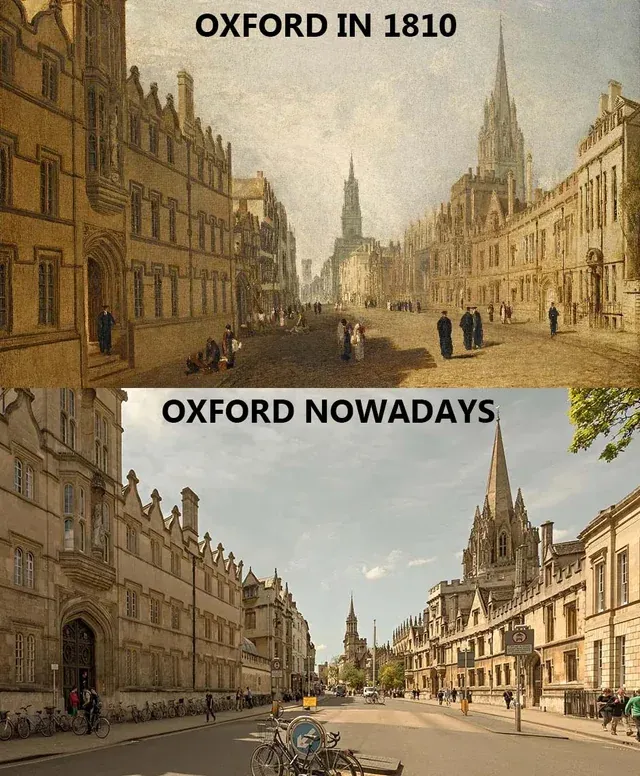
Turner’s painting of Oxford’s High Street (1810) and the same street today — nothing moved.
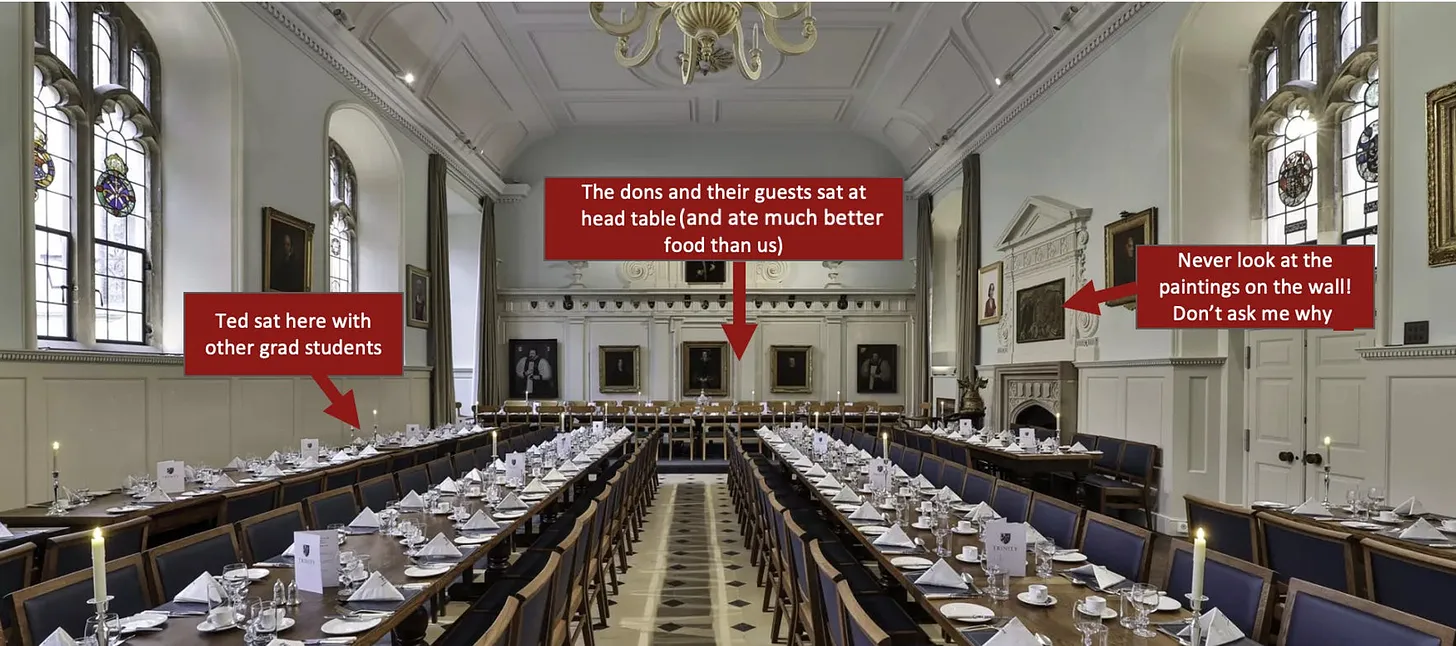
Trinity College dining hall — where even the dinner table had rules enforced in Latin.
The Five Features
1. Everything Is Handwritten
At Oxford, Gioia never owned or touched a typewriter. Every essay, every exam answer, every piece of work was handwritten — and exams were handwritten under proctor supervision. Even his grades were delivered handwritten in ancient Greek characters.
The implication for today: no submission pipeline means no AI pipeline. You cannot paste a ChatGPT response into a handwritten exam booklet.
2. The Tutorial: One-on-One Oral Interrogation
The core of Oxford education is the tutorial — a meeting in the don’s office, typically one-on-one, occasionally with a second student. The student arrives with a handwritten essay, then reads it aloud in front of the tutor, who interrupts constantly with questions. When the reading ends, follow-up questions continue.
“The whole process resembled a police interrogation from a BBC crime show.”
There is no way to cheat in this setting. You either defend your thinking on the spot or you look like a fool. This is, as Gioia notes, exactly like real life.
3. Handwritten and Oral Exams — Supervised and Anonymous
Final results depend entirely on grueling multi-day written exams (handwritten, proctored) and the viva voce — an oral defense before a panel of scholars who weren’t your tutors and know nothing about you except what you’ve written.
The anonymity prevents influence. The orality prevents delegation. The supervision prevents assistance.
For students who performed well enough on the written exams to be exempt from the viva voce (as Gioia was), it was a relief — because the oral defense is the most unforgiving format of all.
4. High Stakes and Real Failure
Many smart Oxford students left without a degree. The system did not hand-hold or boost graduation rates. There were no participation trophies.
This is the credential integrity mechanism: if everyone passes, the degree means nothing. The willingness to let people fail — including elite Rhodes Scholars — is what made an Oxford degree carry weight. Gioia argues this will return by necessity as AI-inflated credentials get devalued everywhere else.
5. Face-to-Face Reputation Building
Beyond exams, reputation at Oxford was built through conversation — at dinner, in the Oxford Union debates, in informal social settings. A student could rise in stature purely through wit and intellectual fluency at the dinner table. Public speaking skill could set you on the path to Prime Minister.
None of this involved technology. You had to think on your feet with people watching. Even a time traveler with a smartphone would have been useless.
Why This Matters Now
Gioia’s framing: the AI cheating crisis is a crisis of assessment design, not a crisis of student morality. The dominant model — written essay submitted digitally for anonymous grading — was always intermediable by any sufficiently capable text generator. AI just made that intermediability obvious and cheap.
The Oxford system was never built to prevent AI; it was built for entirely different reasons. But its features happen to be structurally incompatible with AI assistance:
| Oxford Feature | Why AI Can’t Penetrate It |
|---|---|
| Handwritten under supervision | No submission pipeline |
| Live tutorial interrogation | Cannot delegate real-time reasoning |
| Anonymous oral viva | Cannot impersonate a student in person |
| Genuine failure permitted | Cannot inflate credentials externally |
| Face-to-face reputation | Social context is unsubstitutable |
The Tension Gioia Holds
He mocked this system when he lived it. He found the cap and gown, the Latin grace, the dining hall rules enforced in ancient Greek, and the sconcing rituals absurd. He describes arriving from a South Central LA apartment, carrying cold fried chicken from a Laker Airways budget flight, landing in what felt like a time machine.
The arc: youthful ridicule → adult appreciation. The specific irony: the very features that seemed most backward (no typewriters, handwriting everything, constant oral interrogation) are exactly the features that now look most forward-thinking.
Practicability Objection
The obvious counterargument: Oxford is labor-intensive. American professors would resist spending that much time face-to-face with individual students.
Gioia’s response: US colleges could replace bloated administrative bureaucracies with more teachers. The resources exist; the priorities are wrong. If bold enough, any institution could shift toward personalized, social, face-to-face education with no digital interfaces required.
Connections
- Collapse of the Knowledge System — AI cheating is warning sign #6 (plagiarism normalized) and #5 (university prestige collapse) made acute; the Oxford model is one structural response
- Conversational Authority — Oxford’s face-to-face reputation system is the exact social context where conversational authority is built and tested
- Self-Directed Education — counterpoint: Oxford is highly structured, not self-directed; but both share the conviction that passive, delegated learning produces nothing real
- Deliberate Practice — tutorial interrogation is deliberate practice; you are working at the edge of your reasoning ability with immediate feedback in real time
- Ted Gioia — part of his larger argument that the humanistic, embodied, face-to-face dimensions of education are what survive the AI collapse