Ted Gioia describes his lifetime reading plan as an “extreme sport” — the discipline, consistency, and mental focus of a high-performance athlete, applied to books. He issues the warning upfront: he is not recommending this to anyone. But for those already on a similar path, the specific techniques are worth studying.
The Techniques
1. Orca-Sized Time Blocks
Reading is not squeezed into spare moments — it is the structure of the day.
- Up at 5:30 AM in high school to read before class
- Reads at the start of every day, before work begins
- Reads at lunch, at dinner (before marriage), before sleep
- Even during periods of extreme professional demand, he set the alarm earlier to protect reading time rather than sacrifice it
The reframe: reading is not a leisure activity carved out after obligations. It is the obligation. Everything else fits around it.
2. Read for Mind-Expansion, Not Entertainment
The books Gioia reads are chosen for intensity, not comfort. When he started his first job out of business school, he was reading Sartre’s Being and Nothingness in the mornings — 800 dense pages of French existentialism as a counterweight to the office.
His prescription: at least one or two long, challenging books per year. When others grab beach reads, reach for Thucydides, Gibbon, Schopenhauer, Woolf, Musil. His reading list at age 18–21: War and Peace, Don Quixote, The Brothers Karamazov, Moby Dick, The Tale of Genji, The Magic Mountain.
The principle: if books were a drug, take the big dose.
3. Read Slowly — Slowness Is a Feature
Gioia is not a fast reader. He reads languidly, returning to sentences again and again. He read Proust’s 2,000-page novel at seven pages per day, starting as a teenager and finishing just before his thirtieth birthday.
He used to believe his slow pace was a weakness. He now believes it was a gift. The learning went deeper precisely because it wasn’t rushed. Internalization — not information transfer — is the goal.
Life is not a race. The journey is its own reward.
He draws a parallel to learning jazz piano: he spent months on things others mastered in days, but by the end, the learning was in his body, not just his head.
4. Read Aloud
For language-rich prose and all poetry, Gioia reads aloud. He has read Finnegans Wake and the King James Bible cover to cover this way. Hearing the sounds is essential — it changes the experience of language that was written to be heard, not scanned.
5. Track Everything
He keeps handwritten lists of every book he reads, going back decades. The lists are holistic: if a book was read for work or research, it doesn’t go on the list. The lifetime reading plan tracks only the inner life — the books read for wisdom, for mind-expansion, for the soul.
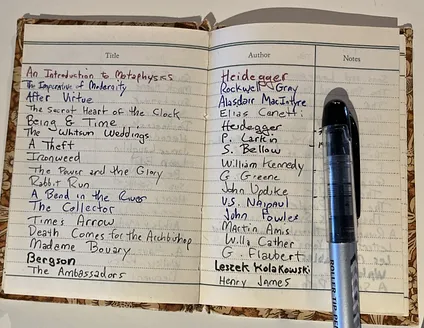
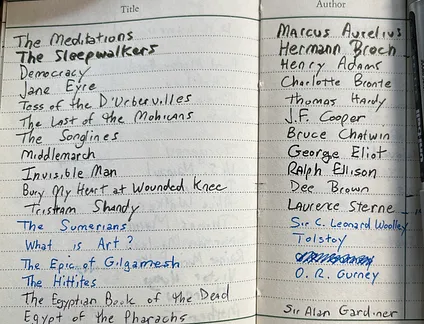
6. Identify Gaps, Make Lists, Read Every Book on the List
After finishing his formal education, Gioia sat down and identified the biggest gaps in his reading. He made a list of the 50 most important books he hadn’t read yet. Then he read every one.
When that was done, he noticed a new gap: history. He made a list from Herodotus and the Egyptians through to modernity. Read every book on that list.
This systematic gap-filling repeated over decades until, by his forties, he could hold his own with specialist professors at Oxford and Harvard — on their specialties.
7. Old Books When Young, New Books When Old
This is the most counterintuitive part of the plan. Most people read what’s current when young and grow more traditional as they age. Gioia did the reverse: his twenties were almost entirely old books — the tradition, the canon. Now, older, he reads mostly living writers.
His reasoning: you need the tradition first to have any real perspective on the present. You can’t properly evaluate what’s new until you know what it’s responding to, departing from, or recovering. He wasn’t ready to write about literary subjects until forty — not because he lacked intelligence, but because he hadn’t yet assimilated what he needed to say anything worth saying.
The Unintended Consequence: Gravitas
Gioia didn’t pursue this reading plan to build a career or a public persona. The inner life and the external vocation were kept deliberately separate. And yet, by his forties, colleagues, professors, and audiences began treating him differently — noticing an authority and resonance he hadn’t possessed before.
He calls it gravitas. It wasn’t performed or demanded. It emerged from the inside, and others noticed it before he did.
How does a jazz musician know so much about Aristotle?
The reading plan had changed him in ways that couldn’t be hidden.
8. Take Notes in Three Levels
Note-taking is not incidental to Gioia’s reading practice — it is integral to it. He describes three levels, each more demanding than the last:
- Mark the book — underline, annotate margins, insert post-its; makes reading active and allows re-experiencing initial impressions years later
- Summarize the book — spend a couple of hours after finishing writing a holistic summary; forces consolidation and creates a reference
- Write your own ideas sparked by the book — the highest level; not notes about the book but thinking generated by it
The critical technique across all three: write in coherent sentences and integrated paragraphs, not bullet points. This forces synthesis in real time and produces something durable enough to understand years later.
His 400+ literary essays in The Vault began as Level 3 notes — never commissioned, written for his own benefit.
The discipline of taking notes can evolve into taking notice — which is a much higher level activity.
See Note-Taking as Thinking for the full framework.
9. The Deep Dive
Separate from the lifetime curriculum, Gioia periodically picks a specific topic and immerses in it for several months — typically reading around a dozen books before moving on. Recent deep dives: origins of Romanticism, Shakespeare’s life and times, decline of the Roman Empire. Next: mysticism as intellectual history.
This is the vertical complement to the curriculum’s horizontal sweep. The curriculum gives breadth across all of human culture; the deep dive gives depth on a chosen thread. Together they prevent the lifetime reading plan from becoming a checklist.
The key distinction: the deep dive is self-initiated and subject-driven, not structured around a pre-made list. It usually emerges from something in the broad reading that demands more attention.
“Reading shouldn’t be a goal, it should be a habit.”
This applies equally to the deep dive and the lifetime plan: the point is not to finish but to build an ongoing practice. The deep dive is just the periodic intensification of that habit.
Prerequisite: The Love of Reading
This methodology assumes a reader who already loves books. The adult practice described here is built on a foundation laid in childhood — joy of storytelling before literacy, free choice of books, role models who read for pleasure. See How the Love of Reading Develops for the conditions Gioia identifies as producing that foundation. Prescribing this methodology to someone without it is like prescribing an elite training plan to someone who hates running.
See Also
- Ted Gioia
- Self-Directed Education
- Reading for Wisdom
- How the Love of Reading Develops — the childhood prerequisite
- Note-Taking as Thinking
- Essays as Thinking Tools — resonance: both are about slow, effortful cognitive engagement vs. fast consumption